Tip
Quick answer: Start the climb at 2 am to reach the summit for sunrise - the most powerful experience on the mountain. The ascent takes 2.5–4 hours (5,500 steps). Peak season is December–May; the path is lit and tea stalls are open. The mountain is closed to tourists during the off-season (May–October). Stay in Dalhousie (the base village) the night before and carry warm layers - the summit is cold. Adam's Peak features in the 10-day Sri Lanka itinerary as a hill country highlight between Kandy and Ella.
Adam's Peak (Sri Pada - "Sacred Footprint") rises to 2,243 metres in the Sabaragamuwa highlands of south-central Sri Lanka. It is revered across four religions: Buddhists believe the summit bears the footprint of the Buddha; Hindus venerate it as the footprint of Shiva; Christians and Muslims associate it with Adam. The combination of spiritual significance and physical drama - a pyramid-shaped peak rising abruptly from forest-covered hills - makes it one of the most compelling destinations in Sri Lanka.
The night climb to reach the summit at dawn is a defining Sri Lankan experience. Thousands of pilgrims - Sinhalese families, Buddhist monks, Tamil devotees, and international visitors - ascend the 5,500 steps together in the hours before sunrise, filling the mountain with the smell of incense, the sound of bells, and the sight of headlamps snaking upward through the dark.
Tip
Our take: The Adam's Peak climb during pilgrimage season (December to April) is a completely different experience from the off-season. Thousands of pilgrims carrying flowers and offerings, tea stalls open at 3 am, the chain of lights stretching 5 km down the mountain - it is a spectacle unlike anything else in Sri Lanka.
The Climb
Route and Distance
The standard route begins in Dalhousie (also spelled Nallatanniya), a small village at the foot of the mountain, 1.3 km above sea level. The path to the summit is 7.5 km (one-way), ascending 900 metres over 5,500 stone steps and concrete staircases built into the mountain face.
The route is well-maintained, lit with fluorescent lights throughout the season, and lined with tea stalls, snack vendors, and resting benches at regular intervals. This is not a wilderness trail - during the season, the path is a continuous stream of pilgrims and visitors, especially on weekends and poya (full moon) days.
The Summit and Sacred Footprint
The Sri Pada (Sacred Footprint) is a depression in the rock at the summit, approximately 1.8 metres long and 0.8 metres wide, enclosed in a golden reliquary. All four religious traditions that venerate the mountain believe the footprint belongs to their own sacred figure - the site is managed by Buddhist monks, and a Buddhist temple occupies the summit.
The summit itself is small - a flat rock platform perhaps 50 metres across, with the temple, the footprint shrine, a large brass bell (pilgrims ring it to mark completion of the climb), and views in all directions when conditions allow.
The Sunrise
The summit sunrise is the reason most non-pilgrims make the predawn climb. On clear mornings, the sun rises over the eastern lowlands, and the mountain casts its famous triangular shadow over the valleys below - a shadow shaped by the peak itself that extends westward as the sun rises, visible for 30–40 minutes before it shortens and disappears.
Arrive at the summit 30 minutes before sunrise (times vary by date - check a Sri Lanka sunrise calculator). The summit fills quickly on clear mornings; position yourself on the eastern face for the best view.
When to Climb
Season: December to May
The pilgrimage season officially opens on the first poya (full moon) after December 1 and closes in May. During this period, the mountain is lit, tea stalls and water stations are open, and the climb is fully accessible.
Peak months: January, February, and March - the driest and clearest conditions, with the best sunrise views. These months also have the highest crowds, particularly on poya days and weekends.
December: The season opens to great ceremony; conditions can be rainy early in the month. Good for atmosphere; variable for views.
April–May: End of season, quieter crowds, acceptable conditions. Temperatures warming slightly.
Off-season: June to November
The mountain closes to tourism during the southwest monsoon. The path lights are switched off, tea stalls close, and the route becomes slippery and potentially dangerous. Do not attempt the climb off-season.
Timing the Climb
Standard approach: Depart Dalhousie at 1–2 am to summit around 5–6 am (sunrise varies 6:00–6:30 am depending on the time of year). This is the most popular timing - the mountain is busy but the dawn arrival is worth the effort.
Alternative: Depart at 3 pm on the day before, summit at sundown, sleep at the summit, and watch the sunrise. Some pilgrims do this; dedicated sleeping areas exist near the summit for overnight stays. Colder and more demanding but gives you the mountain at its emptiest (early evening).
Duration:
- Ascent: 2.5–4 hours depending on pace and crowd density
- Descent: 1.5–2.5 hours
- Total: 4–6 hours
What to Bring
Essential:
- Warm layers - the summit is 8–12°C at dawn, significantly colder than the base (around 15–18°C). Wind chill makes it feel colder.
- Headlamp or torch (the path is lit, but useful for the start)
- Rain jacket - cloud and light rain are possible even in dry season
- Water (stalls open from roughly 2 km up, but carry 1 litre from the base)
- Good footwear with grip - the steps are steep and can be slippery
Useful:
- Trekking poles (rentable at the base)
- Energy snacks (numerous stalls sell hoppers, tea, biscuits at various points)
- Small bag for summit
Leave behind:
- Large packs (unnecessary weight)
- Leather shoes (hard to handle the steps)
The Descent
The descent is harder on the knees than the ascent - 5,500 steps downward is significant. Take your time; use the handrails. Most injuries on Adam's Peak occur on descent, not ascent.
The descent in daylight reveals the mountain environment that was invisible at night: the forest canopy below, the waterfalls visible in side valleys, and views south over the Ratnapura gem-mining region. Allow at least 2.5 hours for the descent.
Where to Stay Near Adam's Peak
Dalhousie (Nallatanniya) - the base village, 1–2 km from the trailhead. Several guesthouses at all price points; these fill in peak season and on poya weekends - book ahead.
Hotels near Adam's Peak (Dalhousie)
Check availability & prices on Booking.com
Powered by Booking.com · We may earn a small commission at no extra cost to you.
Nallathanniya rest houses and guesthouses cost LKR 2,500–6,000/night. Facilities are basic; most include dinner and packed breakfast. The priority is a bed for a few hours before the pre-dawn start - comfort is secondary to location.
Alternative bases:
- Hatton / Dikoya (10 km, 20 minutes) - slightly more accommodation options and facilities, useful if Dalhousie is fully booked.
- Kitulgala (60 km, 1.5 hours) - whitewater rafting town, popular for adventure tourism; some visitors combine Kitulgala with an Adam's Peak climb.
Getting to Dalhousie
From Colombo (140 km, 3.5–4 hours): Via Avissawella and Hatton on the A7. Private hire from Colombo costs LKR 12,000–15,000 each way.
From Kandy (80 km, 2 hours): South via Hatton on the A7. This is the most common approach for travellers on the hill country circuit. By bus: 3 hours, change at Hatton.
From Nuwara Eliya (45 km, 1.5 hours): Via the mountain road through Hatton. Many visitors do Adam's Peak as a night climb from Nuwara Eliya accommodation.
From Ella (130 km, 3 hours): Via Beragala and Hatton. A natural addition to the hill country route after completing the Ella experience.
By train to Hatton: The Colombo–Badulla hill country line (the same scenic Kandy–Ella route) stops at Hatton station. From Hatton, tuk-tuks (30 minutes, LKR 600–800) or bus connections reach Dalhousie.
Adam's Peak Guided Tours
Guided night hikes and sunrise pilgrimages with local experts
The Pilgrim Experience vs The Tourist Experience
Adam's Peak is a functioning pilgrimage site that also happens to attract international tourists. Understanding this distinction improves the experience significantly.
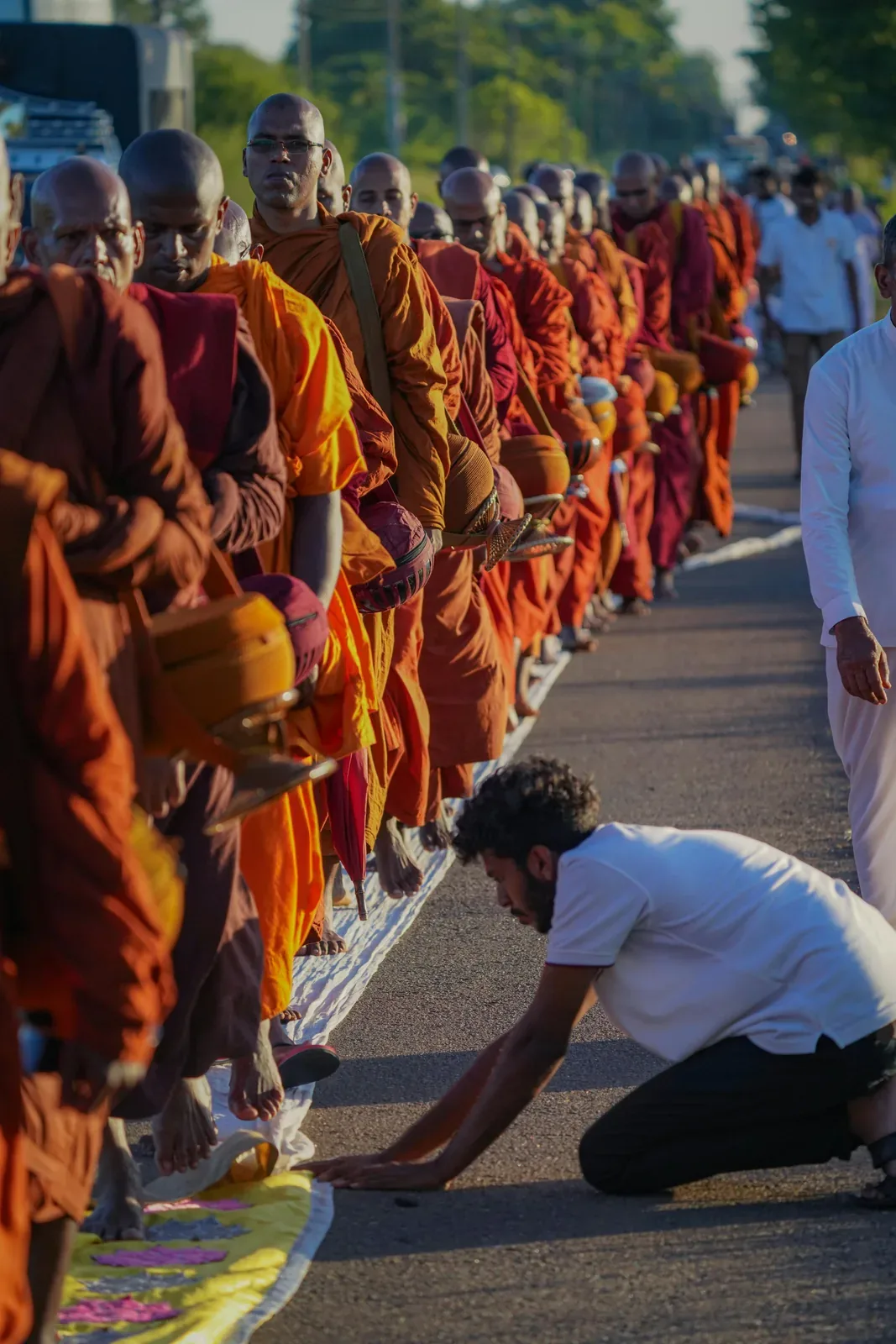
What pilgrims do differently: Sri Lankan pilgrims typically climb in silence or in prayer, offering flowers at the summit shrine, circling the sacred footprint, and descending quickly after the brief sunrise ceremony. Many have climbed it dozens of times across their lives. The first ascent of a devout Buddhist's life is considered a spiritual milestone.
What the atmosphere is like during season: The path during peak pilgrimage season (January to March) is extraordinary - a continuous chain of lights stretching 5 km up the mountain as thousands of people make the same ascent simultaneously. Tea stalls at every station serve hot drinks, rice, and snacks at 2 am. The summit bell rings with each sunrise. This is not a quiet nature hike; it is a shared human experience at significant scale.
Respecting the sacred footprint: The Sri Pada (sacred footprint) at the summit is enclosed in a shrine. Remove shoes at the entrance. Dress modestly - no shorts or sleeveless at the summit shrine. The religious significance of the site is genuine; behaving accordingly is both respectful and received well by local pilgrims.
Practical Cost Breakdown for Adam's Peak (2026)
| Item | Cost |
|---|---|
| Park entry fee | LKR 0 (no entry fee during pilgrim season) |
| Tea/snacks at mountain stalls (per stop) | LKR 100–300 |
| Full dinner at Dalhousie | LKR 500–1,000 |
| Budget guesthouse, Dalhousie (per night) | LKR 2,000–5,000 |
| Mid-range guesthouse, Dalhousie | LKR 5,000–12,000 |
| Tuk-tuk from Hatton to Dalhousie | LKR 600–800 |
| Train Colombo to Hatton (2nd class) | LKR 280 |
| Headtorch batteries (sold at base) | LKR 200–400 |
Adam's Peak vs Other Sri Lanka Hikes
| Hike | Difficulty | Duration | Unique appeal |
|---|---|---|---|
| Adam's Peak | Moderate (stairs) | 3–5 hrs up | Pilgrimage atmosphere, sacred site, night climb |
| Pidurangala | Easy-moderate | 45 mins | Best view of Sigiriya, sunrise over Cultural Triangle |
| Little Adam's Peak (Ella) | Easy | 30 mins | Easy panoramic views, no crowds before 7 am |
| Horton Plains / World's End | Easy (flat) | 2 hrs loop | Dramatic escarpment, cloud forest |
| Knuckles main trail | Hard | Full day+ | Serious trekking, endemic wildlife |
Adam's Peak is the hardest of the mainstream Sri Lanka hikes but rewards the effort with the most culturally distinctive experience.
Adam's Peak: Frequently Asked Questions
How hard is the Adam's Peak climb? Moderately challenging - the 5,500 steps are steep and continuous, but the path is well-maintained with handrails throughout. Reasonably fit adults of most ages complete it regularly. The difficulty increases significantly if you are not accustomed to sustained stair climbing.
Is Adam's Peak safe? Yes, during the season. The path is lit, staffed by attendants at the tea stalls, and busy with other pilgrims and visitors. Off-season climbing is not safe and not permitted.
Can children climb Adam's Peak? Yes - children as young as 6–7 regularly make the climb with families. Allow extra time and take frequent breaks. The descent is harder on children's knees; some families carry younger children for the final section.
What is the best day to climb Adam's Peak? Weekdays in January or February for the clearest skies and smaller crowds. Avoid poya (full moon) days if possible - crowds are extremely large. Saturdays are the busiest day of the week.
Do you need a guide for Adam's Peak? No - the path is impossible to lose, well-signed, and lit throughout the season. However, a guide can provide context on the religious significance of various stopping points along the route.
Is Adam's Peak worth it? For many visitors to Sri Lanka, yes - the combination of the night pilgrimage atmosphere, the physical achievement of the climb, and the summit sunrise is one of the most memorable experiences on the island. It requires planning and an early start, but delivers something genuinely different from the standard Sri Lanka highlights.
What happens at the summit of Adam's Peak? The summit holds the Sri Pada - a 1.8-metre rock depression interpreted as a sacred footprint by four religions (Buddhism, Hinduism, Islam, and Christianity each have their own tradition of what the footprint represents). It is enclosed in a small shrine. A large bell is rung by pilgrims and visitors marking their arrival. Sunrise from the summit is the primary reason most visitors make the climb, though cloud cover frequently obscures it - even a clouded sunrise is a memorable experience from 2,243 metres.
Can you climb Adam's Peak during the off-season (May to November)? The path is not officially open during this period and the tea stalls along the route are closed. Off-season climbing is strongly discouraged: the rock becomes extremely slippery, the path is unlit, and there are no facilities. Several serious accidents have occurred. The pilgrimage season exists partly for practical safety reasons.
What is the difference between climbing from Hatton side vs Ratnapura side? Almost all visitors climb from Dalhousie (Hatton side) - the shorter, more direct route with 5,500 steps. The Ratnapura approach is a traditional pilgrimage route taking 8 to 12 hours for the ascent alone; it is rarely used by international visitors. The Hatton approach is the right choice for a first ascent.
Is there food and water available on the mountain? During pilgrim season, tea stalls operate at regular intervals up the entire route - serving hot tea, coffee, Milo, rice, roti, and snacks 24 hours during peak season. Water is available throughout. You do not need to carry significant provisions, though bringing a water bottle is sensible. Prices increase slightly the higher you go, as you would expect.
Related Guides
- Mirissa Beach Sri Lanka Guide 2026: Whale Watching, Surfing & Where to Stay
- Anuradhapura Sri Lanka Guide 2026: Ancient City, Sacred Sites & What to See
- Nuwara Eliya Sri Lanka Guide 2026: Tea Country, Gregory Lake & Things to Do
- Arugam Bay Surfing Guide 2026: Sri Lanka's Best Surf & East Coast Beach
Advertisement
Flights, hotels and tours - all in one place.
Plan Your Sri Lanka Trip
Find the best price to Colombo from your city
Search Flights →Compare prices across Booking.com, Agoda & more
Find Hotels →Bus fares, train times and transport options
Plan Transport →Powered by Travelpayouts · We may earn a small commission at no extra cost to you.
Leave a Comment
Share your thoughts, questions, or travel experiences