Tip
Quick answer: Polonnaruwa takes a full day - 6 to 8 hours on a bicycle is the ideal way to cover the ancient city. The entry ticket (USD 25 for foreign visitors) covers all sites. Start early (7–8 am) to beat both the heat and the tour buses. Polonnaruwa pairs naturally with Sigiriya and Dambulla Cave Temple in a 3–4 day Cultural Triangle loop, and is a stop on the 10-day Sri Lanka itinerary.
Polonnaruwa was Sri Lanka's second ancient capital - the centre of Sinhalese civilisation from the 11th to the 13th century, after the fall of Anuradhapura. In that relatively short period, a succession of powerful kings built an extraordinary complex of palaces, temples, dagobas (dome-shaped shrines), and irrigation reservoirs across a well-planned medieval city.
What makes Polonnaruwa special among Sri Lanka's ancient sites is the quality of its ruins: they are extensive, largely above ground, and comprehensible as a coherent urban plan. The centrepiece - Gal Vihara, with four colossal rock-cut Buddha statues - is one of the most technically accomplished works of art in Asia.
The site is a UNESCO World Heritage Site and one of the best-preserved ancient cities in South Asia.
Tip
Our take: We always recommend hiring a bicycle at the museum gate rather than touring by tuk-tuk. The ruins are spread over 6 km - cycling between them at your own pace, stopping when something catches your eye, is the only way to experience Polonnaruwa properly.
How to Visit Polonnaruwa
Bicycle: The best way. Hire a bicycle in town (LKR 300–500/day) and cycle the site in a loop - the main road through the ruins is flat and shaded in places. You can cover all the major sites in 4–6 hours at a relaxed pace.
Tuk-tuk: If cycling in the heat is not appealing, hire a tuk-tuk driver for the day (LKR 3,000–4,000). Drivers know the order of the sites and can position you for good photographs.
Guided tour: Official guides are available at the entrance (LKR 2,500–4,000 for 3–4 hours). A good guide adds context that signs alone cannot provide - particularly for the religious iconography and the historical sequence of the buildings.
Entry: USD 25 per foreign adult (LKR equivalent). Valid for one day; covers all sites. Ticket offices at the main entrance and at the museum. Open from 7 am.
Time needed: 4–8 hours for the full site. The museum adds another 45–60 minutes and is worth the time - the scale models and artefacts explain what you are seeing in the ruins.
Gal Vihara
The undisputed highlight of Polonnaruwa and one of the finest works of Buddhist sculpture anywhere. Four images were carved from a single granite face during the reign of King Parakramabahu I in the 12th century:
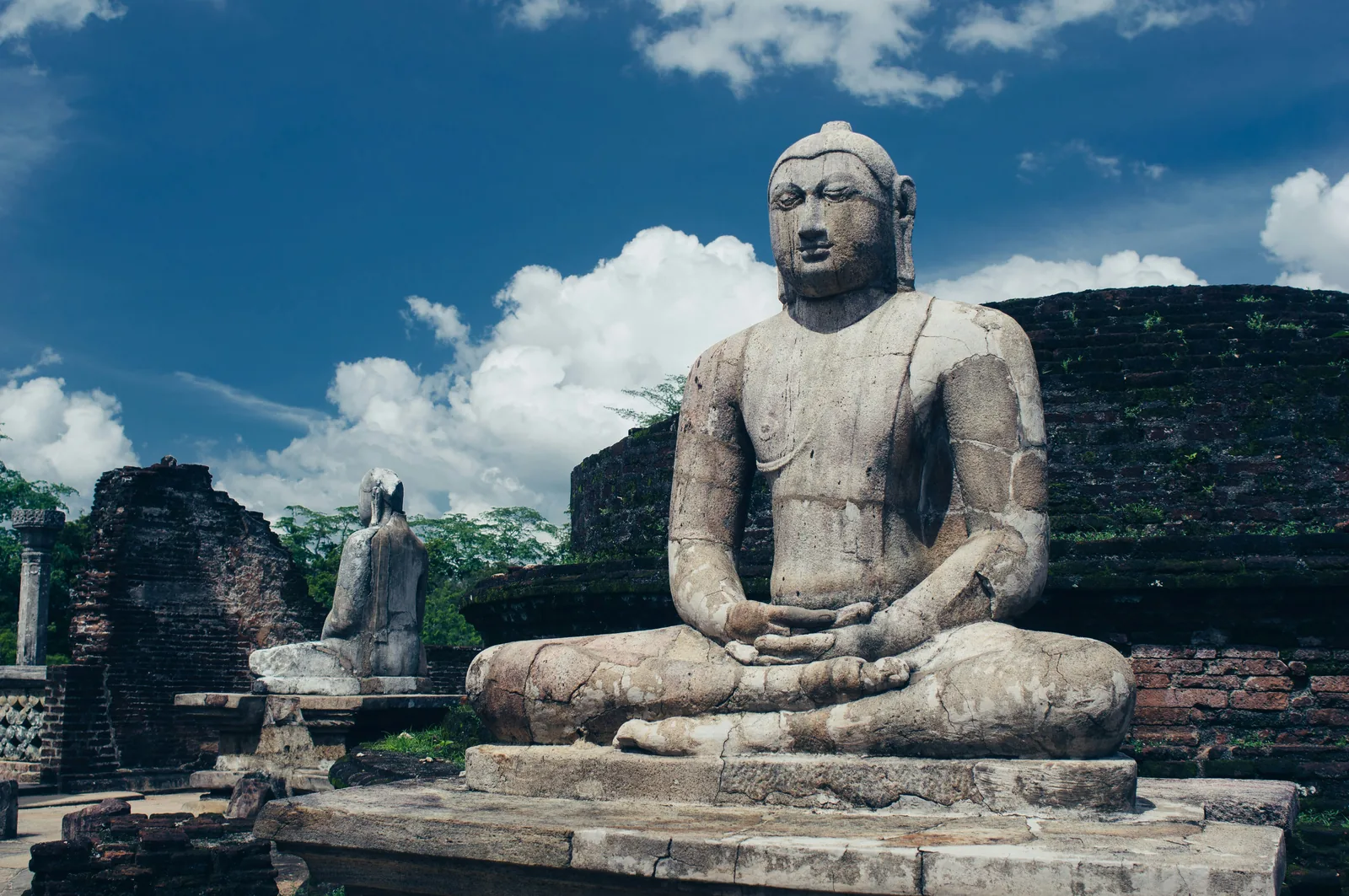
The Seated Buddha (15 metres high): The largest of the four, inside a rock-cut shrine chamber. The statue sits in the dhyana (meditation) mudra with extraordinary precision - the proportions have been adjusted for the slightly upward viewing angle of a person standing before it.
The Standing Buddha (7 metres high): Positioned between the two larger sculptures. Note the unusual posture - arms crossed at the chest rather than in the standard abhaya (blessing) mudra. Scholars debate whether this represents grief (at the parinirvana of the Buddha) or a now-lost convention.
The Reclining Buddha (15 metres long): The Parinirvana - the Buddha entering final nirvana. The scale is commanding; the face has an expression of complete serenity. The soles of the feet show the 108 auspicious symbols of a Buddha, though they are now worn.
The Small Seated Buddha: Cut into an arched niche in the rock, this smaller figure is the most intimate of the four - a shrine within the larger composition.
Shoes must be removed before approaching the statues. Photography is permitted but touching the sculptures is prohibited.
The Quadrangle (Dalada Maluwa)
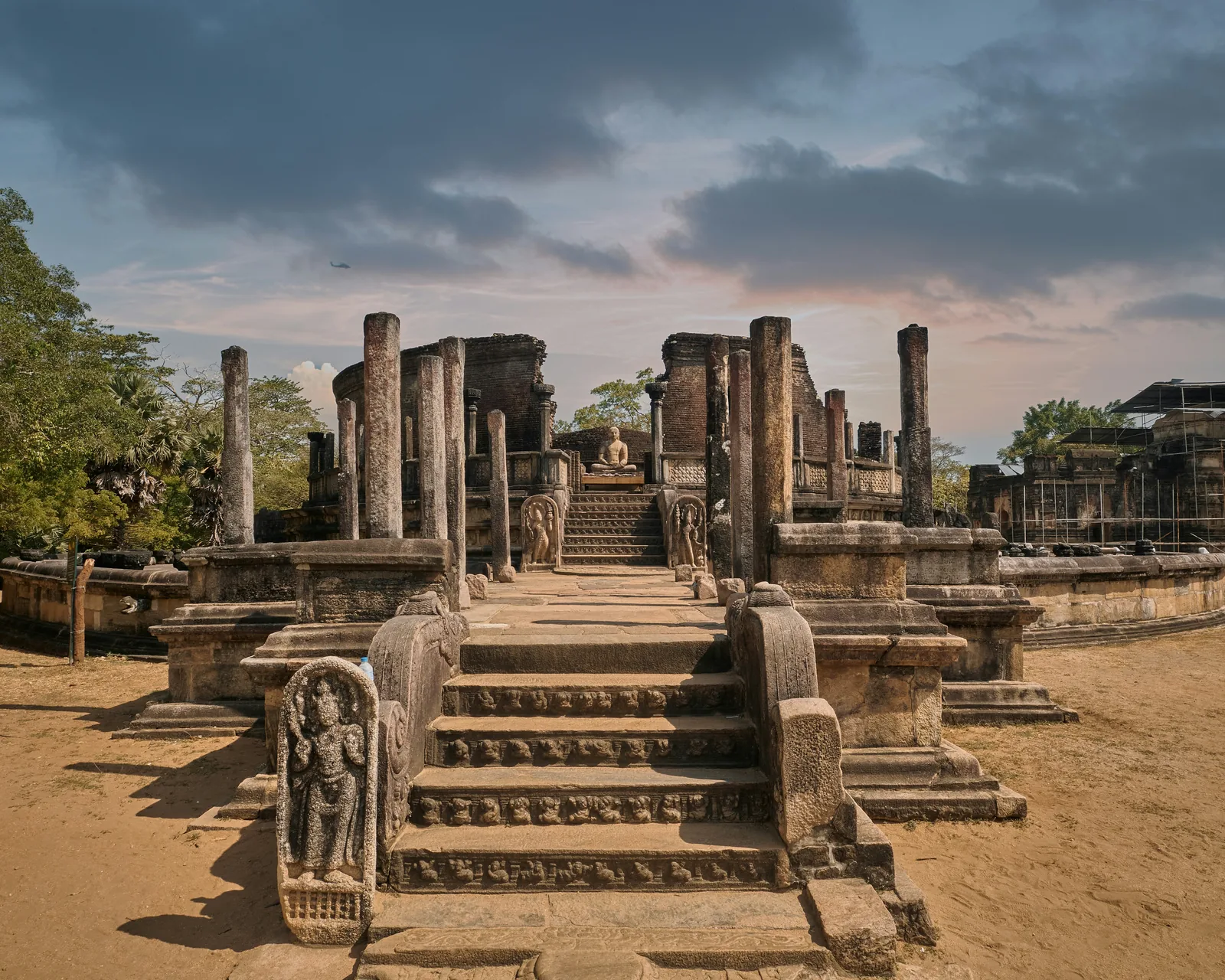
A compact, high-density cluster of religious buildings within a raised enclosure - the sacred heart of the 12th-century city. The most important structures:
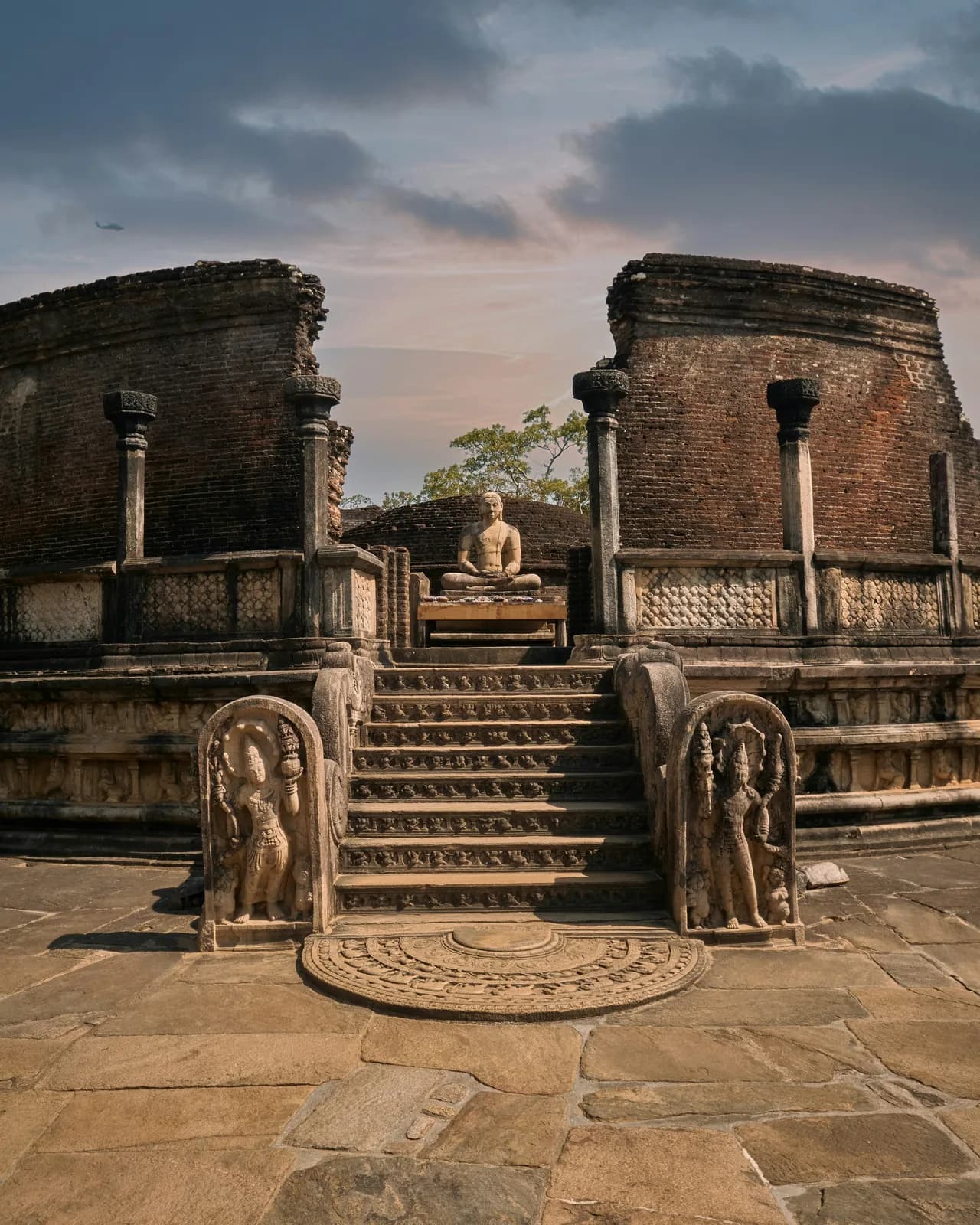
Vatadage (Circular Relic House): The most perfectly preserved structure in Polonnaruwa. A circular platform with a small central dagoba, surrounded by four Buddha statues facing the cardinal directions, and enclosed by two concentric walls. The moonstone at the northern entrance is considered one of the finest in Sri Lanka.
Thuparama Image House: The only complete building in Polonnaruwa - a solid-walled gedige (image house) still standing with its roof intact after 800 years. The interior is lit through narrow slits in the thick walls; the original lime plaster is visible on the inside. The only entrance to the interior is through the low arched doorway - you must duck to enter.
Hatadage (Tooth Relic Shrine): A two-storey building constructed by King Nissanka Malla to house the Tooth Relic of the Buddha. The ground floor has three shrine rooms, each originally containing a seated Buddha statue.
Gal Pota (Stone Book): A 9-metre slab of stone inscribed with an account of the reign of Nissanka Malla - essentially a royal advertisement carved in granite. The slab weighs 25 tonnes and was transported 100 km from Mihintale.
Royal Palace Group
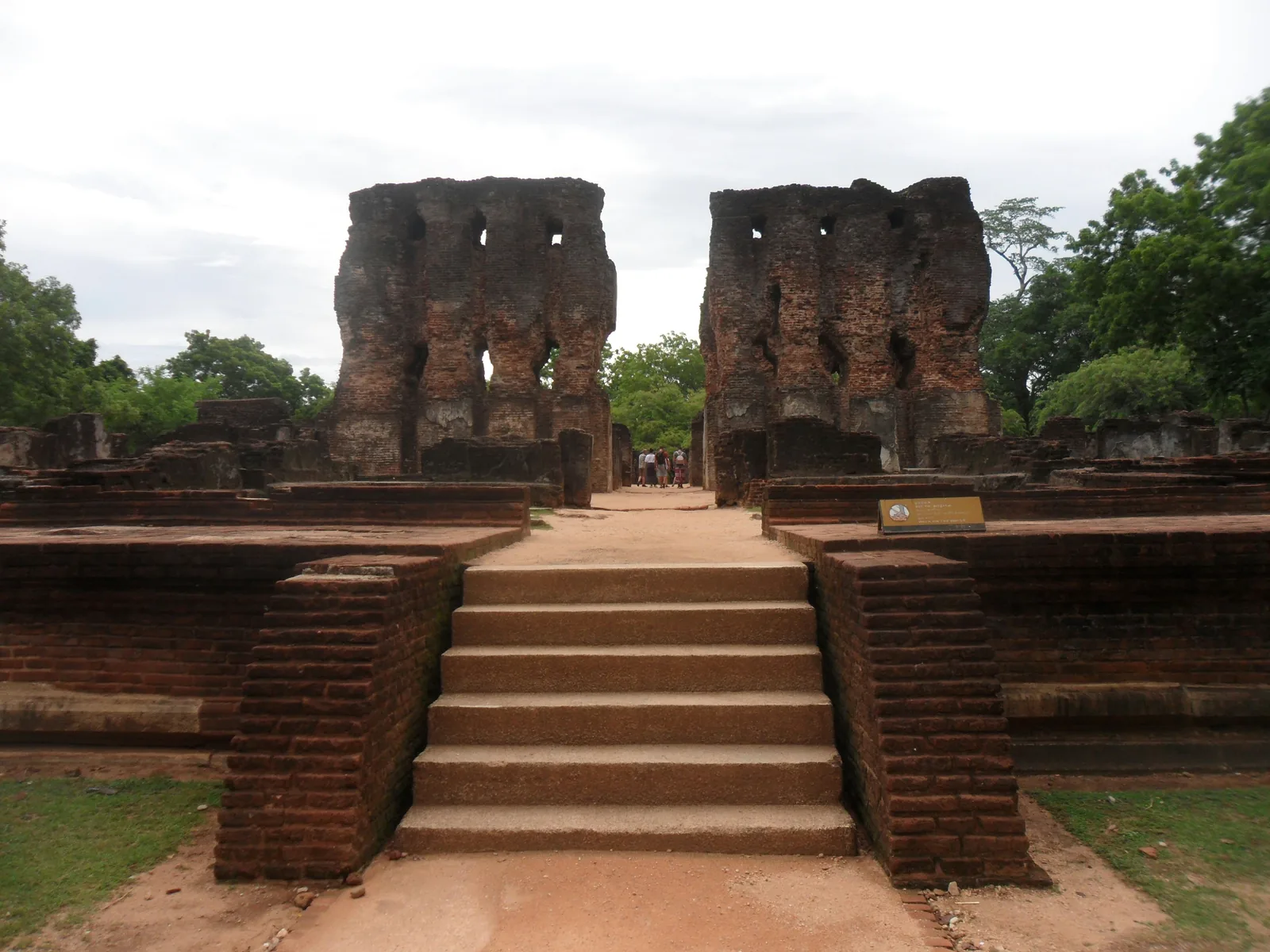
The remains of the palace of King Parakramabahu I, the greatest of Polonnaruwa's rulers, who unified the island and undertook the city's most ambitious building programme.
Royal Palace: According to the Mahavamsa (the Sri Lankan royal chronicle), the original palace was seven storeys high with 1,000 rooms. The surviving brick walls stand 10 metres high and show the beam-holes for the upper floors. The scale communicates the ambition of the original - even ruined, it is a commanding structure.
Audience Hall: Adjacent to the palace, with well-preserved elephant frieze running around the base of the platform. Each elephant is individually carved in a different pose - the craftsmanship is extraordinary for a decorative base.
Royal Bathhouse: Two bathing pools - one small, one large - with an intact stone water-supply channel. The pools are lined with dressed stone and still hold water when the water table is high.
Parakrama Samudra
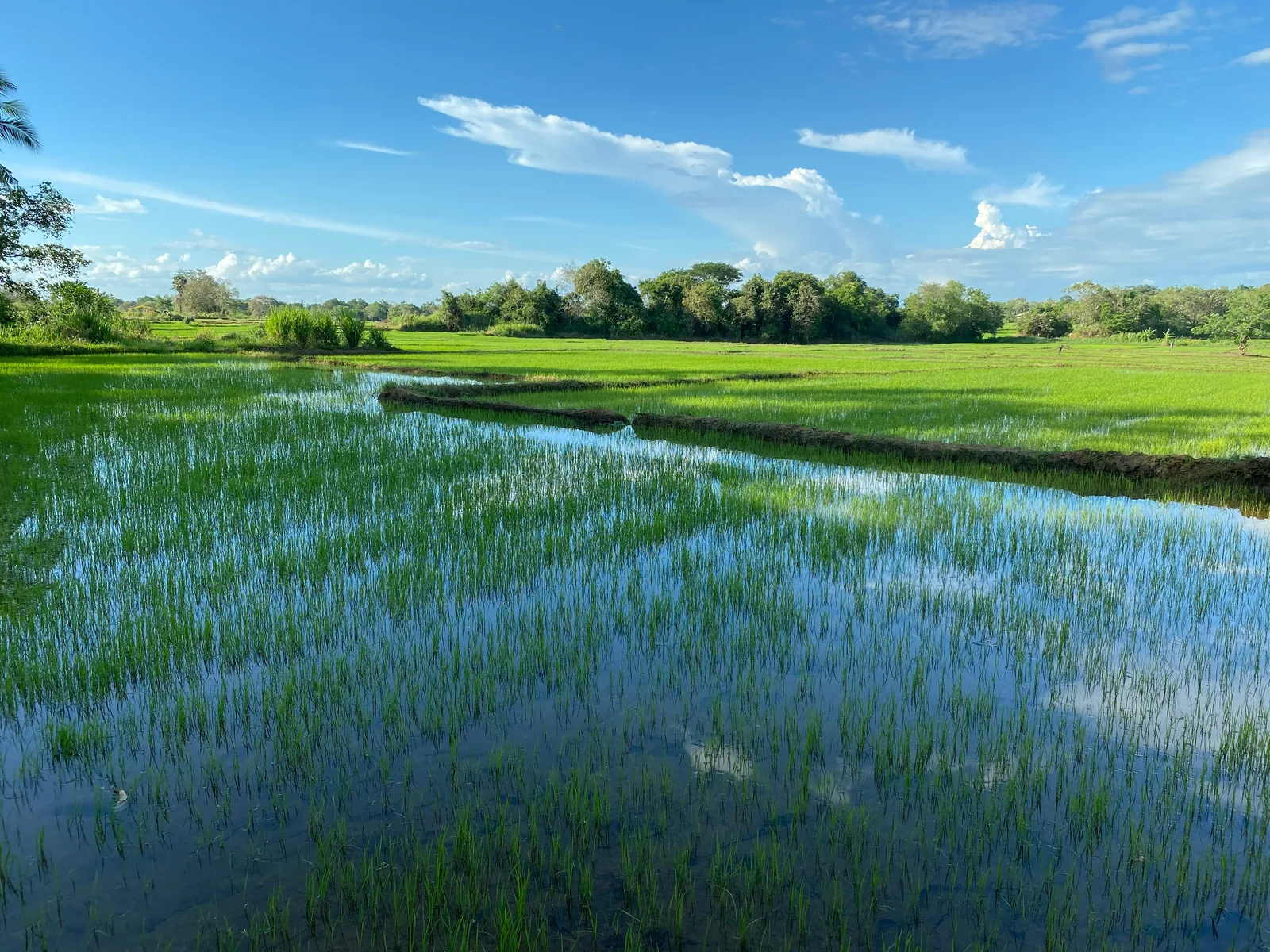
The largest ancient reservoir in Sri Lanka, built by King Parakramabahu I in the 12th century. The bund (dam wall) is 14 km long; at full capacity the reservoir holds 134 million cubic metres of water. It is still in active use - the modern rice paddies around Polonnaruwa are irrigated by the same system, barely modified, that fed the medieval city.
The view from the bund road at sunset is one of the finest in the Cultural Triangle: the still water reflects the sky, and the silhouette of the Parakrama Samudra statue (a 3.5-metre granite figure on the bund, identity disputed - king or sage) is a landmark image of Polonnaruwa.
Walk or cycle the bund in the early morning or evening for the best light and to avoid the midday heat.
Rankot Vihara
The largest dagoba in Polonnaruwa at 55 metres high - a red-brick stupa visible from across the site, built in the late 12th century. Rankot Vihara follows the same architectural formula as the great dagobas of Anuradhapura, reduced to a manageable scale: a hemispherical dome on a square platform, surrounded by subsidiary shrines and image houses.
The red colour comes from the original fired brick - most dagobas in Anuradhapura are whitewashed. The brick surface at Rankot Vihara is original and gives it a more ancient appearance than the whitened monuments further north.
Lankatilaka Temple
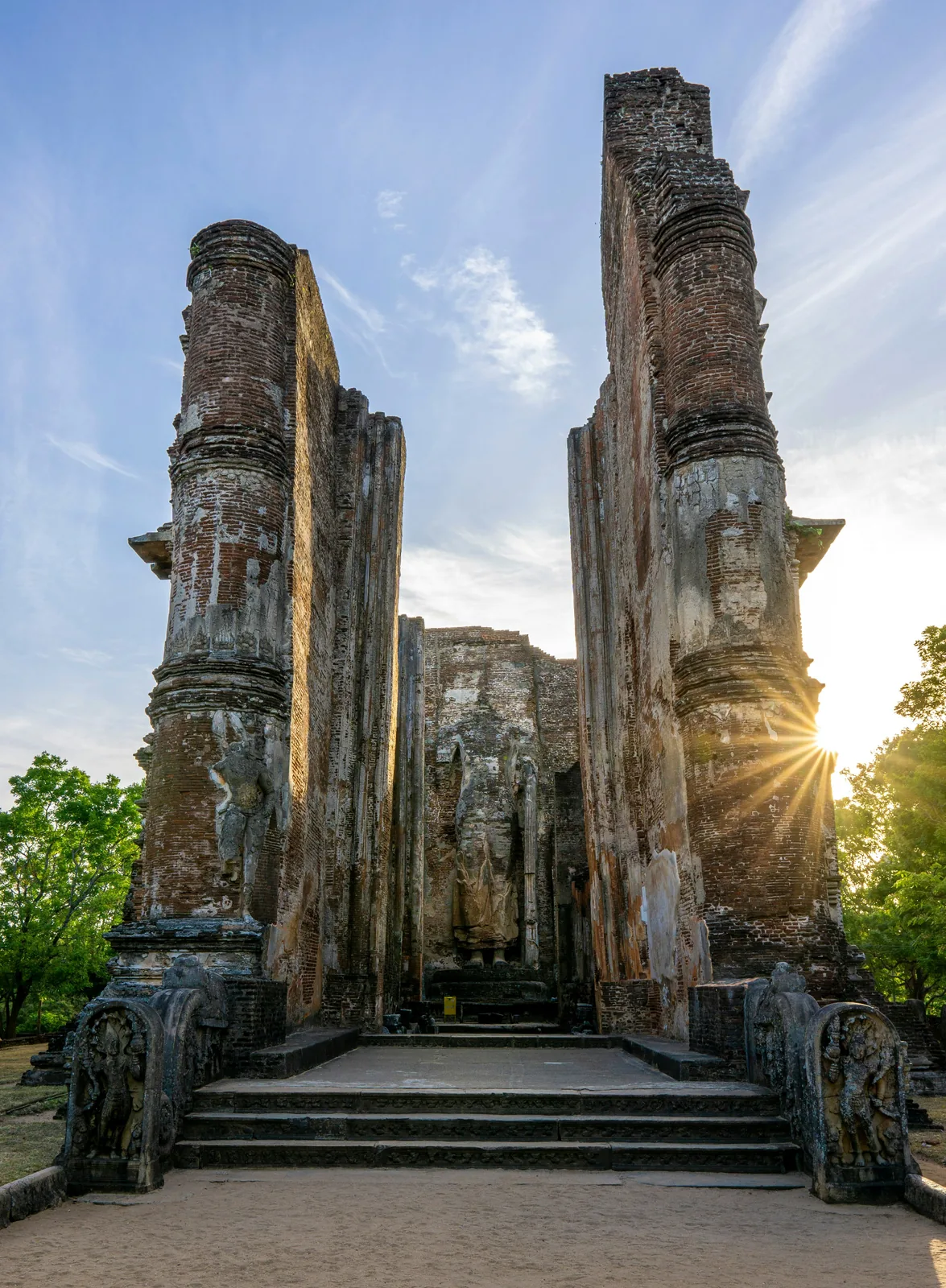
An image house of exceptional scale - the outer walls stand 17 metres high even in their ruined state. The interior contains a colossal headless standing Buddha (the head fell during the city's abandonment), surrounded by carved decorative panels depicting divine figures and scenes from Buddhist legend.
The architecture is a sophisticated blend of Sinhalese and South Indian styles - the result of Sri Lanka's extensive cultural exchange with the Tamil kingdoms of southern India during the Polonnaruwa period. The carved detail on the exterior walls is some of the finest decorative work surviving from medieval Sri Lanka.
Tivanka Image House
Located in the northern section of the site, 3 km from the main cluster - worth the extra cycling distance. Tivanka houses a standing Buddha in the "thrice-bent" (tivanka) posture unique in Sri Lankan religious sculpture: hips, shoulders, and head each turned in a different direction, creating a flowing S-curve rarely attempted in stone.
The interior walls retain fragments of the finest surviving examples of Polonnaruwa-period fresco painting - scenes from Jataka stories (previous lives of the Buddha) in orange, red, and ochre. Most paint is lost, but what remains gives a sense of how brilliantly decorated these buildings once were.
Polonnaruwa Museum
Before entering the ruins, spend an hour at the museum (included with site ticket) on the main road. The scale models of the Quadrangle and the Royal Palace are essential for understanding what you will see - the ruins make much more sense once you have seen a reconstruction.
The artefact collection includes bronze Bodhisattva statues, stone inscriptions, carved architectural elements, and ceramics from the city's occupation period. The level of detail in the 12th-century bronzes in particular demonstrates that Polonnaruwa at its height was a major centre of fine craftsmanship, not merely military and administrative power.
Where to Stay
Hotels in Polonnaruwa
Check availability & prices on Booking.com
Powered by Booking.com · We may earn a small commission at no extra cost to you.
In Polonnaruwa town: The most convenient base. Several guesthouses and mid-range hotels within 2–5 km of the site entrance. The Lake Hotel (on the Parakrama Samudra bund) has the best location - rooms face the reservoir.
Day trip from Dambulla or Sigiriya: Polonnaruwa is 70 km east of Dambulla (1.5 hours by road). Many visitors prefer to base themselves in Sigiriya or Dambulla and do Polonnaruwa as a long day trip, returning in the evening.
Budget: Family guesthouses in the new town from LKR 3,000–5,000/night. Clean and practical; limited restaurant options nearby.
Mid-range: Ekho Lake House and Deer Park Hotel are the established options in the LKR 8,000–15,000 range, both with pools.
Getting to Polonnaruwa
From Sigiriya (70 km, 1.5 hours): By car or tuk-tuk on the main road through Dambulla. The most common route on a Cultural Triangle circuit.
From Dambulla (68 km, 1.5 hours): Same road as Sigiriya; Dambulla is a natural midpoint.
From Kandy (140 km, 3 hours): By car via Dambulla. By train: the Batticaloa line stops at Polonnaruwa train station, 4 km from the site - trains from Kandy take 4–5 hours.
From Colombo (210 km, 4–4.5 hours): By car on the A6 via Kurunegala and Dambulla, or by expressway to Kurunegala and then north. By bus: Polonnaruwa-bound buses depart Colombo Bastian Mawatha and take 5–6 hours.
Practical Information
Entry fee: USD 25 per foreign adult (approximately LKR 7,800 at 2026 rates). Children under 12 free. Purchase at the main ticket office near the museum, or at the Gal Vihara ticket window.
Opening hours: 7 am–6 pm daily. The site can be entered in the early morning; Gal Vihara has separate access hours (typically 7 am–5 pm).
Best time to visit: December–April (dry season). The site is accessible year-round but June–October brings intermittent monsoon rain. Early morning (7–9 am) is best for light and cooler temperatures.
Dress code: Shoulders and knees covered at all religious sites. Shoes must be removed at Gal Vihara and at functioning temple buildings. Bring socks - the stone paths can be hot.
What to bring: Water (at least 1.5 litres per person), sun hat, sunscreen, and closed-toe shoes suitable for cycling.
Monkeys: Toque macaques are common throughout the site. Do not feed them and keep bags closed - they will take food and small items left unattended.
Polonnaruwa vs. Anuradhapura
Both are UNESCO World Heritage ancient cities in Sri Lanka's Cultural Triangle. The key differences:
| Polonnaruwa | Anuradhapura | |
|---|---|---|
| Period | 11th–13th century | 4th century BC–11th century AD |
| Scale | Compact, one day | Sprawling, needs 1–2 days |
| Condition | Better preserved | More ruinous but more atmospheric |
| Highlights | Gal Vihara, Royal Palace | Sacred Bodhi Tree, Ruwanwelisaya |
| Cycling | Flat, easy | Flat, longer distances |
| Tourist infrastructure | Moderate | Well-developed |
Both cities are worth visiting. Polonnaruwa is the better first stop if time is limited - it is more legible and the sculpture quality at Gal Vihara is unmatched. Anuradhapura has more historical depth and religious significance for Sri Lankan Buddhists.
Polonnaruwa Guided Tours
Ancient city tours with expert archaeologists and local historians
Frequently Asked Questions
How long does Polonnaruwa take? A full day - 6 to 8 hours including travel to and from the site. If arriving from Sigiriya or Dambulla, allow 7 am arrival and plan to leave by 3–4 pm to avoid the return journey in darkness.
Can I do Polonnaruwa as a day trip from Kandy? Yes, but it is a long day - 3 hours each way by car, leaving 2–3 hours at the site. Most visitors prefer to overnight in Polonnaruwa or Dambulla and combine the visit with Sigiriya and Dambulla Cave Temple.
Is Polonnaruwa worth visiting? Yes, particularly for Gal Vihara, which is among the finest Buddhist sculpture in Asia. Even visitors with limited interest in archaeology typically find the site more engaging than expected - the ruins are extensive, well-preserved, and set in a pleasant landscape.
What is the best way to see Polonnaruwa? Bicycle, hired at the site entrance for LKR 300–500. The flat terrain and shade trees on the main road make cycling comfortable in the early morning; in the heat of midday a tuk-tuk is more practical.
Is Gal Vihara the best thing to see in Polonnaruwa? Yes. Allocate extra time here - the four sculptures repay slow looking. The standing figure in particular shows a mastery of stone-carving that places it among the great works of Asian sculpture.
Can I combine Polonnaruwa and Sigiriya in one day? It is possible but rushed. Sigiriya Rock takes 2–3 hours minimum; Polonnaruwa needs a full day. The two sites are 70 km apart. If time is very short: visit Sigiriya in the morning, Polonnaruwa in the afternoon - but expect to miss half of Polonnaruwa.
What is the entry fee for Polonnaruwa in 2026? USD 25 per foreign adult. The ticket covers all sites within the ancient city. Purchase at the museum ticket office or the Gal Vihara window.
Related Guides
- Sigiriya Rock Fortress: The Complete Travel Guide (2026)
- Anuradhapura Sri Lanka Guide 2026: Ancient City, Sacred Sites & What to See
- Dambulla Cave Temple Guide 2026: Sri Lanka's Golden Temple & Rock Caves
- Kandy, Sri Lanka: The Complete Travel Guide (2026)
Advertisement
Flights, hotels and tours - all in one place.
Plan Your Sri Lanka Trip
Find the best price to Colombo from your city
Search Flights →Compare prices across Booking.com, Agoda & more
Find Hotels →Bus fares, train times and transport options
Plan Transport →Powered by Travelpayouts · We may earn a small commission at no extra cost to you.
Leave a Comment
Share your thoughts, questions, or travel experiences