Tip
Quick answer: Galle Fort takes 3–4 hours to explore on foot - the rampart walk, Dutch Reformed Church, lighthouse, and National Maritime Museum are the highlights. Stay inside the fort for the full experience (boutique hotels from $80/night). The best approach is the train from Colombo (2.5 hours, scenic coastal route) or the Southern Expressway (1.5 hours by car). Most visitors combine Galle with a stay at Mirissa beach or Unawatuna.
Galle Fort is one of the best-preserved colonial fortifications in Asia and Sri Lanka's only UNESCO World Heritage Site on the south coast. Built by the Portuguese in 1588 and extensively fortified by the Dutch in the 17th century, the fort has evolved into a living town of approximately 400 families - with Dutch Reformed churches, 300-year-old warehouses converted into boutique hotels, and rampart walls that drop straight into the Indian Ocean.
It is a place where a morning walk genuinely rewards you: each street corner reveals a different layer of history, from Portuguese-era walls to Dutch gabled buildings to Victorian-era additions. And unlike many heritage sites, Galle Fort is lived in - school children walk to class past 17th-century gates, fish is sold from boats below the lighthouse, and families gather on the ramparts at sunset.
Tip
Our take: Galle Fort rewards staying inside the walls for at least two nights. Day-trippers see the ramparts and main street. Staying overnight, you get the fort at 6 am with local schoolchildren and fishermen - the same streets feel like a completely different place.
What Makes Galle Fort Different
Most visitors arrive expecting a monument and find instead a neighbourhood. The fort covers 36 hectares within its rampart walls - large enough that the streets feel genuinely urban, small enough that you can walk every corner in a morning.
Three hundred years of layered history have produced a built environment unlike anything else in Sri Lanka. Dutch gabled buildings sit beside colonial-era churches. Streets are named after Dutch governors. The grid layout - unusually orderly for Sri Lanka - reflects Dutch urban planning of the 1600s. And the ramparts, still intact after a 2004 tsunami that caused severe damage outside the walls, stand as one of the Indian Ocean's great engineering achievements.
The fort today functions as both a heritage zone and Sri Lanka's most concentrated district of boutique hospitality, with independent hotels, restaurants, and galleries occupying restored colonial buildings.
The Rampart Walk
The single best activity in Galle Fort. The perimeter ramparts - approximately 1.4 km - can be walked in 45 minutes, but most visitors take two hours to pause at each bastion and watch the light change across the ocean.
Start at the Main Gate (the Clock Tower side) and walk anti-clockwise. Key stops:
Flag Rock Bastion - the westernmost point of the fort, where the lighthouse stands. At sunset, this is one of Sri Lanka's most-photographed spots: the lighthouse, the ramparts, and the Indian Ocean all in one frame. Local families gather here from 5 pm onward.
The Lighthouse - built by the British in 1938, replacing a series of earlier structures. Still operational. The view from the base (you cannot climb inside) encompasses the full sweep of the south coast.
Triton Bastion - the southern face of the ramparts, where the walls are thickest. The ocean below is navigable for swimming in calm conditions (April–September); the rocks just outside the walls are where you will find the stilt fishermen working at low tide.
Aeolus Bastion - the southeastern corner, quieter than Flag Rock, with excellent views over the fishing harbour.
Moon Bastion - the northeastern corner, where the ramparts reconnect with the Main Gate area. The view here overlooks the cricket ground, one of the most scenic sporting venues in the world, where international matches are occasionally still played.
Main Highlights Inside the Fort
Dutch Reformed Church (Groote Kerk)
Built in 1755, this is the oldest Dutch Reformed church in Sri Lanka and one of the finest examples of colonial ecclesiastical architecture in South Asia. The interior floor is paved with tombstones of Dutch colonial officials - a practice common in Protestant churches of the period. The church is still used for services and is open to visitors at most hours.
The building itself is striking: whitewashed Dutch gable facade, original wooden pews, and a bell tower that serves as a navigational landmark from the sea. The cemetery attached to the church predates the building - Dutch settlers were buried here from the earliest days of their occupation.
National Maritime Museum
Housed in a restored Dutch warehouse, the National Maritime Museum documents Sri Lanka's maritime history from ancient trading routes through the colonial period to the present. The collection includes traditional fishing boats, navigational instruments, and exhibits on the 2004 tsunami - particularly powerful given the fort's own survival of the disaster.
Worth 45 minutes for anyone interested in the south coast's relationship with the sea. The building itself is a heritage attraction: original teak floors, colonial-era brick construction, and a courtyard that predates the main museum.
The Old Gate (Zwart Bastion Gate)
The original Portuguese fortification entry point, later rebuilt by the Dutch. The VOC (Dutch East India Company) coat of arms remains above the gateway, one of the few VOC emblems still in its original position in Asia. Worth visiting specifically for the carvings.
Historical Mansions
Several private collectors have opened their 17th-century houses as small museums. The most visited is the Historical Mansion on Leyn Baan Street, which displays an eclectic collection of antiques, colonial furniture, Dutch tiles, and old maps assembled over decades. Free entry; the owner is usually on site and knowledgeable about the objects.
Where to Eat in Galle Fort
The fort has Sri Lanka's most concentrated collection of quality restaurants outside Colombo. Prices are higher than elsewhere on the south coast - budget LKR 1,500–3,500 ($5–12) for a full meal.
Pedlar's Inn Café - reliable all-day option on Pedlar Street; good rice and curry at lunch, Western breakfasts in the morning.
Fort Printers - the restaurant of the fort's most celebrated boutique hotel; Sri Lankan dishes with premium ingredients in a restored colonial dining room. Book ahead for dinner.
Church Street Social - relaxed outdoor restaurant on Church Street; popular for sundowners and light meals. The terrace overlooks one of the fort's quieter residential streets.
Fortaleza - rooftop bar and restaurant at the top of the ramparts; the view compensates for higher prices. Best at sunset.
Pedlar's Inn Pâtisserie - homemade pastries, fresh bread, and espresso coffee; ideal for breakfast before the rampart walk.
Where to Stay in Galle Fort
Staying inside the fort is significantly more expensive than staying in Unawatuna or along the surrounding coast - but it is also a fundamentally different experience. Waking up to the sound of the ocean from a colonial-era building, walking to breakfast on empty streets before the day-trippers arrive, watching the evening light fall on 300-year-old walls - this cannot be replicated from a beach resort five kilometres away.
Boutique Hotels in Galle Fort
Check availability & prices on Booking.com
Powered by Booking.com · We may earn a small commission at no extra cost to you.
Key properties inside the fort:
Fort Printers - the most celebrated address in Galle Fort. A restored 17th-century printing house, now a 10-room boutique hotel. Colonial architecture preserved throughout; pool in the courtyard; restaurant considered one of the best on the south coast. Mid-to-upper range.
The Bartizan - smaller boutique property on the ramparts. Rooms have ocean views from the fort walls. Consistently praised for personalised service.
Galle Fort Hotel - the original fort boutique hotel; slightly larger than the others, with a rooftop pool. Strong reviews for the restaurant and location on Church Street.
Outside the fort - Unawatuna (see below) has extensive mid-range accommodation from $30–60/night; the beach towns east and west have budget options from $15/night. All require transport to visit the fort itself.
Unawatuna and Day Trips
Unawatuna Beach - 5 km from Galle Fort (10 minutes by tuk-tuk). The most accessible beach from the fort: a sheltered bay with calm swimming, a coral reef for snorkelling, and a dense strip of restaurants and guesthouses. Busy in high season (December–March) - see the full Unawatuna guide for what to expect.
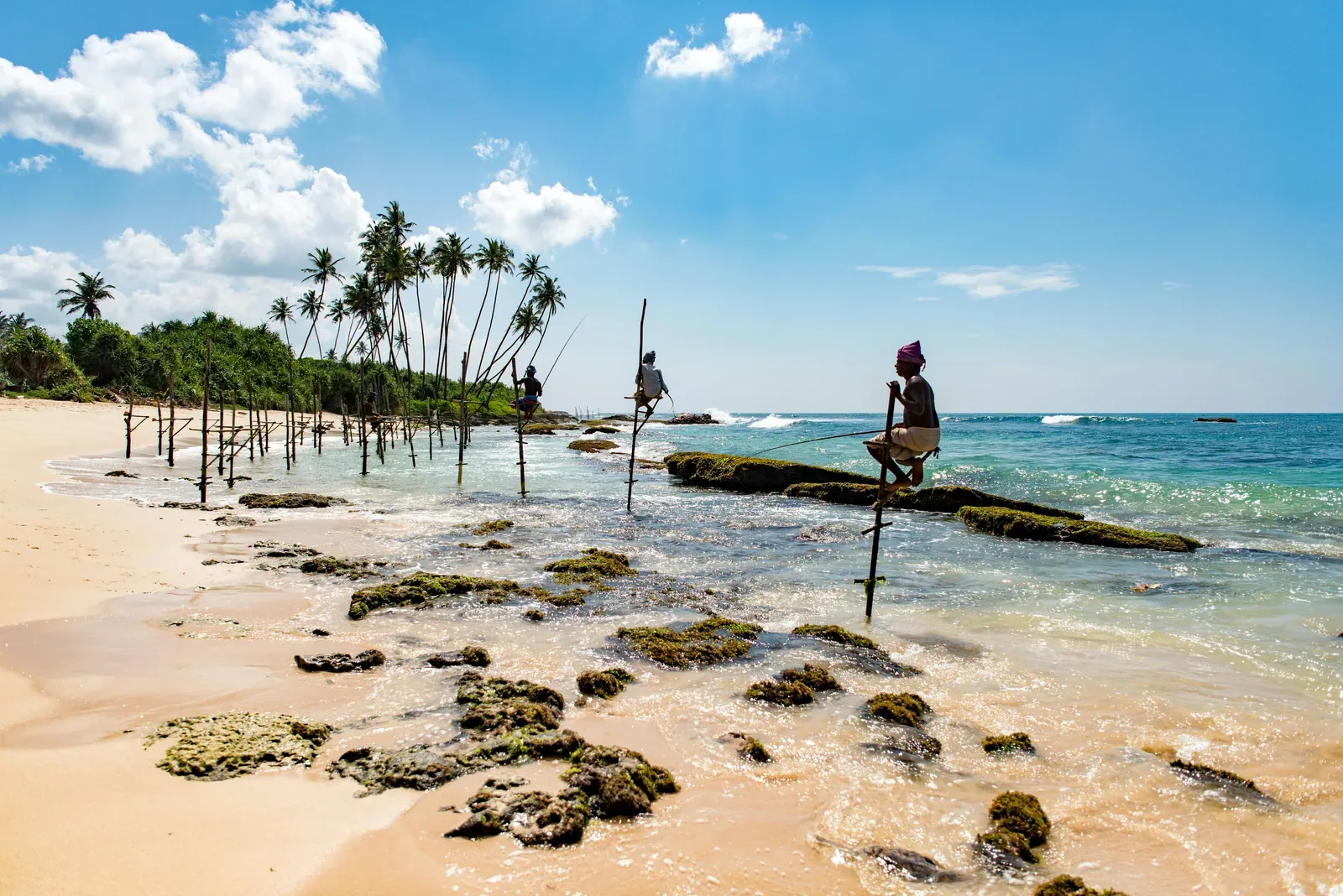
Koggala - 12 km east of Galle. This is where the stilt fishermen practice the traditional "stilt fishing" technique for which southern Sri Lanka is famous. The practice is photogenic but increasingly staged for tourists; early morning (before 8 am) is when working fishermen are out.
Hikkaduwa - 18 km north of Galle. Coral reef snorkelling and budget beach accommodation; livelier and more backpacker-oriented than Unawatuna. The coral gardens here were damaged by the 2004 tsunami but have partially recovered.
Mirissa - 35 km east of Galle. Sri Lanka's best whale-watching location (blue whales, November–April). See the full Mirissa guide.
Martin Wickramasinghe Folk Museum - in Koggala village, this open-air museum documents traditional Sri Lankan rural life. The writer Martin Wickramasinghe was born in Koggala; the museum is set in the ancestral home and surrounding buildings. Underrated by international visitors.
Getting to Galle
By train from Colombo: The coastal train is the most scenic option. Colombo Fort station to Galle takes 2.5–3 hours on the Coastal Line; the journey hugs the shoreline, passing fishing villages and coconut groves. Second class seats are comfortable and do not require advance booking. Trains run every 1–2 hours. See train schedules here.
By car/highway: The Southern Expressway connects Colombo to Galle in 1.5 hours - fast but scenically unremarkable. Tuk-tuks, private cars, or bus connections are available for the final stretch.
By bus from Colombo: AC buses take 2.5 hours on the expressway and are cheaper than taxis. The Galle bus station is 10 minutes by tuk-tuk from the fort.
From Ella or Kandy: Most visitors doing the classic route (Colombo → Sigiriya → Kandy → Ella → Yala → Galle) arrive by private driver from the south coast, which takes 2.5–3 hours from Yala. This route is covered in the 10-day Sri Lanka itinerary.
Practical Information
When to go: Galle's high season is December–March (dry on the south coast). The southwest monsoon (May–September) brings heavy rain and rough seas. October–November is shoulder season with some rain but smaller crowds.
Time to allow: Half a day for the fort itself; stay overnight if you want the full experience.
Entry: No admission fee for the fort. The National Maritime Museum charges LKR 500 for foreign visitors.
Getting around inside: The fort is small enough to walk entirely. Tuk-tuks will take you in but streets are narrow and walking is faster.
Book Galle Fort Tours & Day Trips
Galle Fort walking tours, whale watching from Mirissa, and south coast day trips from Colombo.
What Most Visitors Miss in Galle Fort
The clock tower and church quarter. Most visitors walk the southern ramparts and main street then leave. The northern quarter - around Groote Kerk (the Dutch Reformed Church, built 1755) and the old cemetery - is significantly quieter and contains some of the fort's oldest headstones with inscriptions in 18th-century Dutch. A 20-minute detour from the main circuit.
Dawn at the ramparts. Galle Fort is a different place at 6 am. No day-trippers, local residents crossing to the morning market, fishermen mending nets at the lighthouse end, the Indian Ocean lit by early sun. If you stay overnight, this is the experience that makes it worth it.
The living community. About 400 families still live inside the fort walls. Children go to school, women hang washing from colonial-era balconies, small neighbourhood temples operate alongside boutique hotels. The contrast between this everyday life and the high-end tourism layer is part of what makes Galle Fort interesting - it has not been hollowed into a museum.
The Dutch Hospital. Just outside the fort entrance, the 17th-century Dutch Hospital has been converted into a high-end restaurant and retail precinct. It is worth walking through for the architecture - a long, vaulted building with thick walls designed to stay cool in the tropics - even if you don't eat there.
Koggala stilt fishermen: arrive early. The iconic stilt fishermen visible 10 km east of Galle at Koggala are a genuine cultural practice, though increasingly supplemented by paid tourist photography. Arrive before 7 am in December through April to see active fishing. After 8:30 am, most transition to photo sessions for hire.
A Half-Day Galle Fort Circuit
For visitors with 3 to 4 hours, this circuit covers the main sights without rushing:
Start: Fort entrance gate (park here or arrive by tuk-tuk) 9 am: Walk the eastern ramparts south toward the lighthouse - ocean views east and west from the highest point in the fort 9:45 am: Lighthouse and flagrock end - the original Dutch lighthouse (now a modern rebuild) marks the fort's southern tip 10:15 am: Walk the western ramparts north - views over the harbour and fish market below 10:45 am: Groote Kerk, the old Dutch church and cemetery - the oldest surviving Dutch building in Sri Lanka 11:15 am: Main street (Church Street, Pedlar Street) for the fort's cafés, galleries, and boutiques 12 noon: Lunch at one of the rampart restaurants - Heritage Café or Fortaleza for views over the sea
This circuit is about 3 km of walking. Take water - the fort retains heat and there is limited shade on the ramparts.
Galle Fort: Frequently Asked Questions
Is Galle Fort worth visiting? Yes - it is one of the most distinctive heritage sites in Sri Lanka and genuinely unlike the fort towns found in other parts of Southeast Asia. The combination of intact Dutch colonial architecture, living community, ocean ramparts, and quality restaurants makes it worth at least a half-day stop on any southern route.
How long should I spend in Galle Fort? 3–4 hours covers the rampart walk and main sights comfortably. Stay overnight if you want to experience the fort at dawn and dusk when day-trippers have left.
Can you swim near Galle Fort? Not directly below the ramparts - the rocks and currents make it unsafe. Unawatuna beach (5 km) is the nearest safe swimming beach; Jungle Beach (accessible from Unawatuna) is calmer and less crowded.
How do I get from Galle to Mirissa? By tuk-tuk: 45 minutes, approximately LKR 1,500–2,000. By bus: change at the Galle bus station, takes about 1 hour. By taxi: 35 minutes.
Is Galle Fort safe? Very safe. Sri Lanka has low crime rates generally, and the fort is well-patrolled. Watch for tuk-tuk drivers near the fort entrance who will try to lead you to their preferred shops - politely decline if you prefer to explore independently.
When were the stilt fishermen working? Koggala's stilt fishermen work in the early morning, primarily during the dry season (December–April). By mid-morning, many transition to posing for tourist photographs for a small fee. Arrive before 8 am to see authentic fishing.
What is the best hotel inside Galle Fort? Fort Printers is consistently rated the top address for quality and setting. For ocean views from the ramparts, The Bartizan. For the best central location at a slightly lower price, Galle Fort Hotel.
Related Guides
- The Ultimate 12-Day Luxury Sri Lanka Itinerary: Tea, Wildlife & the South Coast
- Sri Lanka's Traditional Masks: The Art, the Ritual and Where to Find Them
- Ceylon Cinnamon: Why Sri Lanka's 'True Cinnamon' Is in a Different Class
- Mirissa Beach Sri Lanka Guide 2026: Whale Watching, Surfing & Where to Stay
- Anuradhapura Sri Lanka Guide 2026: Ancient City, Sacred Sites & What to See
Advertisement
Flights, hotels and tours - all in one place.
Plan Your Sri Lanka Trip
Find the best price to Colombo from your city
Search Flights →Compare prices across Booking.com, Agoda & more
Find Hotels →Bus fares, train times and transport options
Plan Transport →Powered by Travelpayouts · We may earn a small commission at no extra cost to you.
Leave a Comment
Share your thoughts, questions, or travel experiences