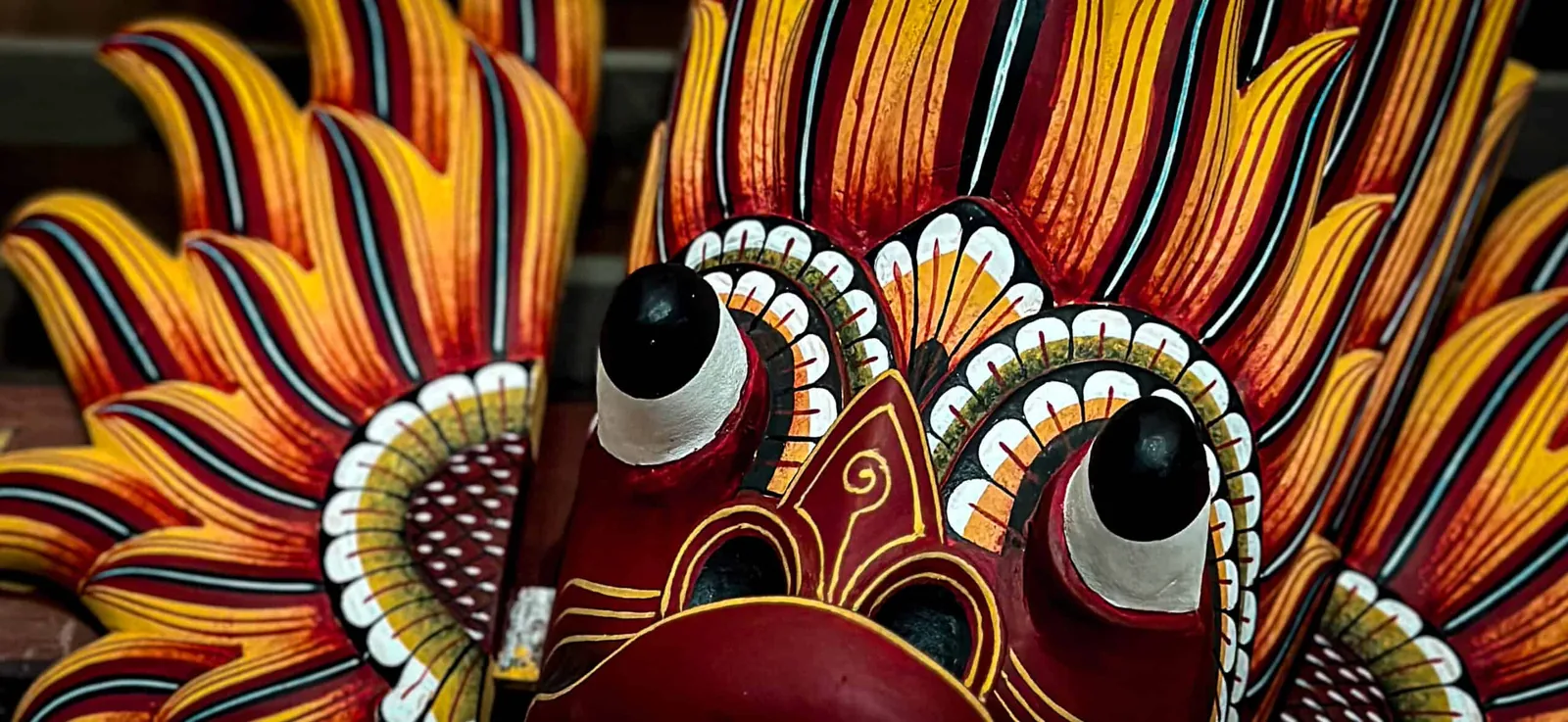
Walk through any craft market in Sri Lanka and the masks will stop you. Vivid, wild-eyed, teeth bared - they seem too alive to be souvenirs. And in a sense, they are. Sri Lanka's wooden masks are not decorative objects dressed up with cultural backstory. They are ritual instruments, each one designed for a specific purpose: to repel demons, heal the sick, tell stories, or hold disorder at bay.
Understanding what you are looking at completely changes the experience of buying one.
Fly into Colombo (CMB) and head south to Ambalangoda - Sri Lanka's mask-making capital - in under two hours.
Planning a Trip to Sri Lanka?
Flights to Sri Lanka
Find the best price to Colombo from your city
Powered by Travelpayouts · We may earn a small commission at no extra cost to you.
Tip
Our take: The Ariyapala mask museum in Ambalangoda gives the best context for understanding Kolam and Raksha mask traditions - significantly better than buying from a tourist shop without knowing what you are holding. The workshop section, where carvers are actually working, is the part worth spending time in.
A Living Tradition with Ancient Roots
Sri Lanka's mask tradition did not begin on the island. Its origins trace back to performance and healing practices that arrived from Kerala and Malabar on the south-western coast of India, carried across the Palk Strait as communities and their rituals moved between the two coastlines over many centuries.
What Sri Lankan craftsmen and performers did with those influences, however, was entirely their own. Over generations, the masks became more elaborate, more vibrant, and more deeply embedded in a distinctly Sri Lankan understanding of illness, spirit, and social order. The Indian originals and the Sri Lankan versions diverged into quite different traditions, with the island's craftsmen adding layers of colour, decoration, and symbolic complexity not found elsewhere.
Today, the heart of Sri Lanka's mask tradition is the small coastal town of Ambalangoda, about 87 kilometres south of Colombo on the Southern Expressway. If you have any interest in craft, ritual, or visual culture, it is worth the detour.
The Three Types of Sri Lankan Masks
All Sri Lankan masks fall into three broad categories, each with its own purpose, appearance, and performance context.
1. Raksha Masks - Demon Protectors
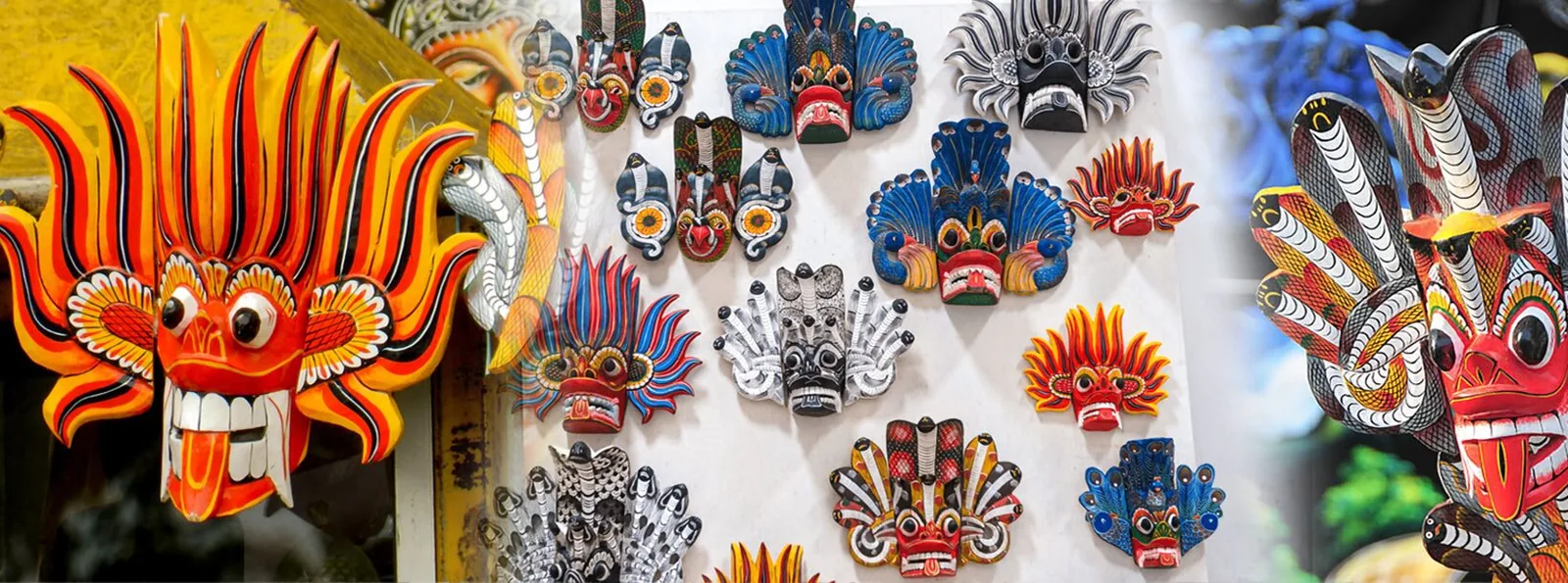
Raksha means demon in Sinhala, and these masks look exactly as that suggests. They are the most theatrical of the three types: large, exaggerated, and designed to be seen from a distance during outdoor processions and festivals.
The defining features are bulging eyes, flared nostrils, a wide gaping mouth, and a protruding tongue. Many Raksha masks also incorporate cobra hoods - particularly the famous Naga Raksha, or Cobra Demon mask, whose hood frames the face and whose stare is deliberately unsettling.
These masks are worn during festival processions, where their fearsome appearance is meant to frighten away evil spirits and protect the community. The logic is straightforward: if you want to repel demons, you need something more frightening than what you are trying to drive away.
Raksha masks are the ones most commonly sold as souvenirs, and the most widely recognised outside Sri Lanka. But stripping them of their procession context reduces them to aesthetics. In their original setting, they were active participants in community protection.
2. Sanniya Masks - The Healers
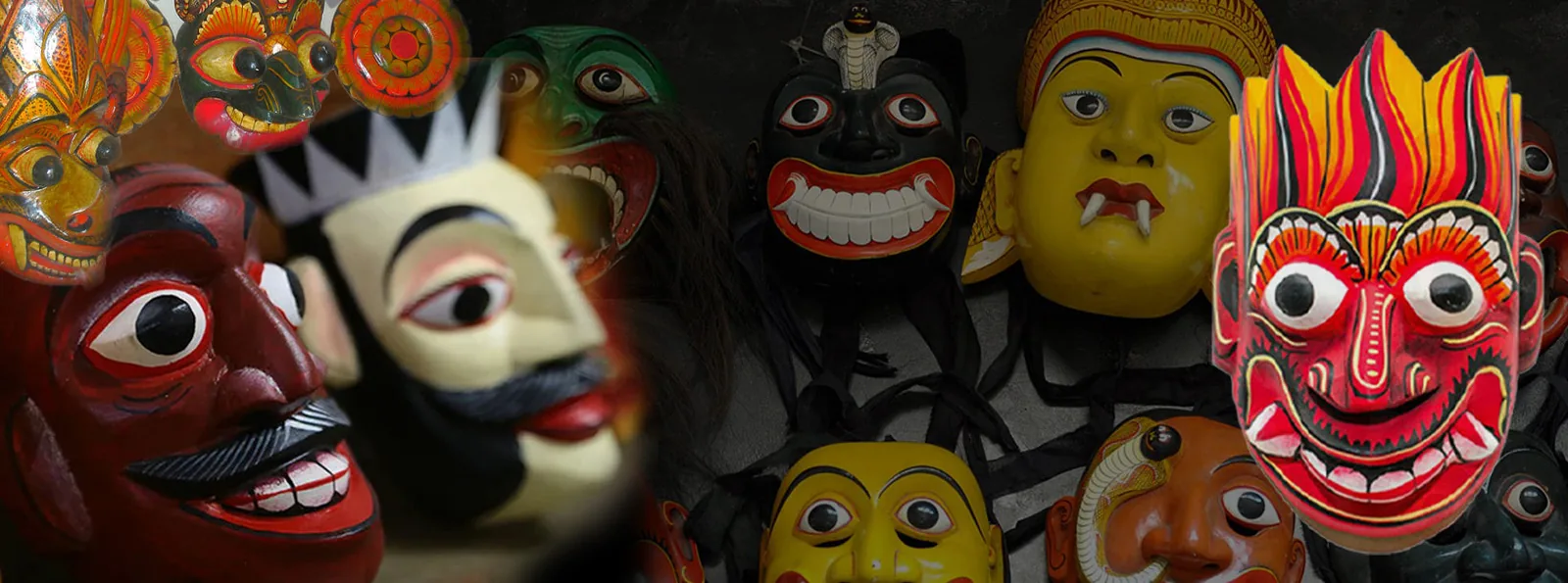
The Sanniya masks are the most complex and culturally significant of the three types. They are used in a healing ritual called Shanthi Karmaya - a ceremony designed to relieve people from illness at a time when sickness was understood to be caused by demonic interference rather than physical processes.
The central feature of this tradition is the Daha Ata Sanniya - the 18 Sanniya demons. Each demon is responsible for a specific ailment, and each has its own mask. A complete set of 18 masks is required to perform the full ceremony, which addresses the full range of human suffering: blindness, deafness, lameness, abdominal disorders, limb distortion, phlegmatic illness, and many others.
The 18 demons and their associated ailments include:
| Demon | Ailment |
|---|---|
| Kana Sanniya | Blindness |
| Bihiri Sanniya | Deafness |
| Kora Sanniya | Lameness |
| Buta Sanniya | Limb distortion |
| Jala Sanniya | Vomiting and dysentery |
| Gulma Sanniya | Abdominal swelling |
| Vata Sanniya | Flatulence |
| Kola Sanniya | Pneumonia |
| Slesma Sanniya | Phlegmatic disease |
The remaining nine demons address a further range of conditions, each precisely defined within the system's internal logic.
Note
Historical significance: The Australian Museum in Sydney holds a complete Daha Ata Sanniya set collected in 1911, including two devil masks and ceremonial accessories. One mask in the collection - representing the demon Garrah-Yakka - is over 100 years old and remains one of the finest surviving examples of the tradition.
Oral tradition links the Shanthi Karmaya ceremony to the ancient city of Vaishali in Bihar, India, suggesting that the healing ritual predates Sri Lanka's own recorded history and arrived as part of a much older tradition of understanding illness through a spiritual framework. The ceremony was historically performed across the southern and western coastal regions of Sri Lanka.
Sanniya masks are less immediately striking than the Raksha type, but they reward closer examination. Their expressions are subtler - the faces of entities that cause suffering rather than entities that frighten it away - and the carving is often more refined.
3. Kolam Masks - Storytellers and Social Satirists
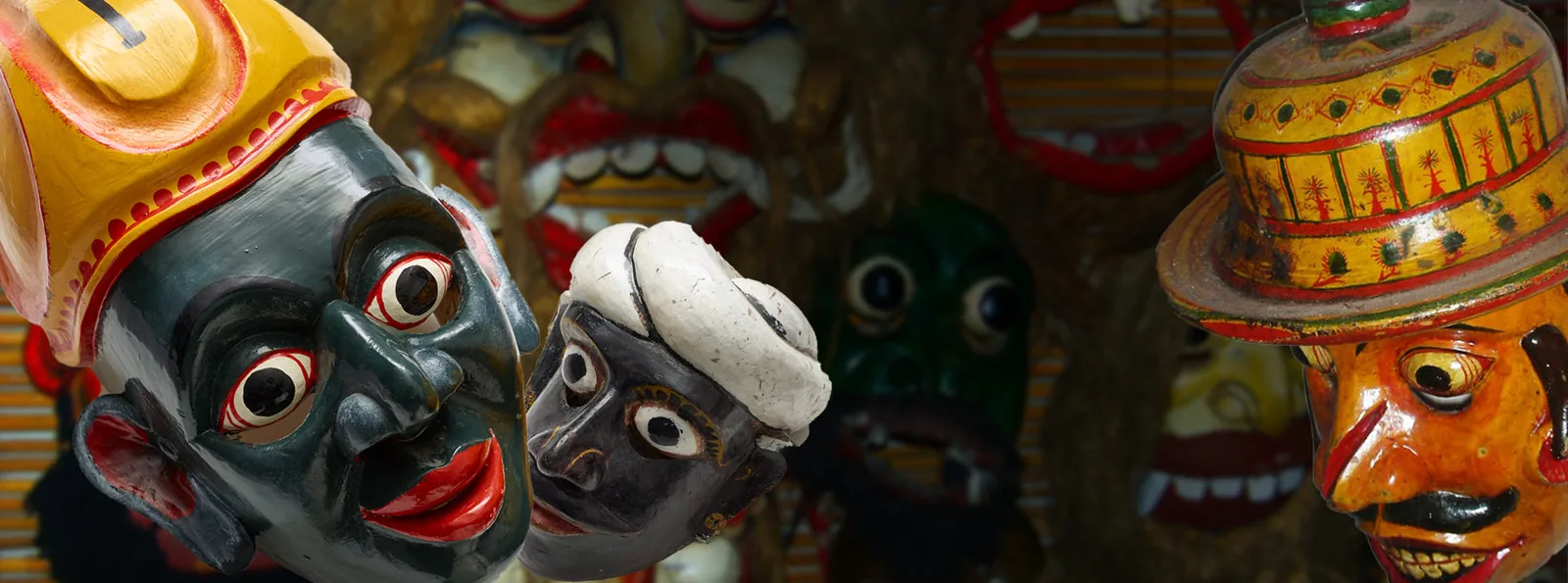
Kolam masks are the storytellers. Where Raksha masks deal with demons and Sanniya masks address illness, Kolam masks depict the full range of human and animal characters: kings, queens, ministers, merchants, clowns, animals, and folk heroes.
Kolam performances are dance-dramas that use these characters to tell stories - often stories that comment on the social order, mock authority, and give audiences a sanctioned space to laugh at power. During the colonial era, Kolam performances became particularly pointed, satirising the behaviour of colonial officials and the disruptions of foreign rule in ways that direct speech could not.
The characters in a Kolam set range from the stately to the absurd. A king's mask will be serene and elaborately crowned. A clown's mask will be grotesque and comical. The contrast is deliberate - Kolam performances move between dignity and ridicule, using the masks to signal instantly to an audience what kind of character has entered the story.
How the Masks are Made
All three types of masks are hand-carved from Kaduru wood - also known as Nux vomica or strychnine tree - a light, pale-coloured timber that grows throughout Sri Lanka's coastal lowlands. Kaduru has several properties that make it ideal for mask-making: it is light enough to wear comfortably during long performances, soft enough to carve with precision, and durable enough to survive the rigours of ritual use.
The process follows a sequence that has remained largely unchanged for generations:
- Selecting the timber - Kaduru logs are chosen for straightness of grain and absence of knots that would complicate carving
- Rough shaping - The basic form is cut with a large chisel before finer tools take over
- Detailed carving - Eyes, teeth, decorative elements and surface texture are carved with increasing precision
- Smoke-drying - The carved mask is smoke-dried for approximately one week, which hardens the wood, drives out moisture, and helps the paint adhere more durably
- Painting - Traditional mineral pigments give way to modern paints, but the colour palette remains consistent: vivid reds, greens, yellows, and black, applied in the patterns specific to each mask type
A master craftsman can produce a high-quality mask over several days. Complex pieces - particularly full Sanniya sets - represent weeks of skilled work and command correspondingly serious prices.
Tip
Buying tip: When shopping in Ambalangoda, the difference in quality between workshop pieces and mass-produced tourist masks is significant. Workshop pieces show tool marks and slight irregularities that are signs of hand carving. Machine-produced masks have uniform surfaces and identical features. The genuine article is worth the higher price, both as an object and as support for working craftsmen.
Ambalangoda: Sri Lanka's Mask Capital
The town of Ambalangoda, on the coast of Galle District, is where the Sri Lankan mask tradition has been concentrated for generations. The town has several mask workshops where visitors can watch craftsmen at work, and a local mask museum that displays examples of all three types alongside explanations of their ritual context and carving techniques.
The museum is small but well-organised, and seeing masks in an explanatory setting before buying changes the experience considerably. Very few antique original masks survive in private hands - the museum holds reproductions, but their purpose is primarily educational, and the staff can answer questions about the tradition that most market vendors cannot.
The workshops around Ambalangoda vary considerably. Some are family operations that have been carving for three or four generations; others are newer enterprises producing primarily for the tourist market. The former typically offer better quality and more willingness to explain what you are looking at.
Ambalangoda is 30 minutes north of Galle. Galle Fort makes an excellent base for exploring the southern coast, including the mask workshops of Ambalangoda.
Where to Stay near Ambalangoda
Hotels near Galle
Compare prices across Booking.com, Agoda & more
Powered by Travelpayouts · We may earn a small commission at no extra cost to you.
A Tradition Under Pressure
The mask tradition in Ambalangoda is genuine but fragile. The ritual performances that gave the masks their original purpose - the Shanthi Karmaya healing ceremonies, the Kolam dance-dramas, the Thovil exorcism rituals - are in significant decline. As the performances fade, so does the demand for masks made to the standards those performances require.
The contemporary mask industry is sustained primarily by tourism, which creates a commercial incentive to produce quickly and cheaply rather than to the standards of working ritual objects. The craftsmen who maintain the older standards tend to be older themselves, and the number of young people entering the trade as serious practitioners rather than producers is small.
This is not a reason to avoid Ambalangoda or to treat what you find there with suspicion. It is a reason to seek out the better workshops, to ask questions, and to be willing to pay prices that reflect genuine skill. A mask bought from a craftsman who carved it by hand in a family workshop is a different object from one that came off a production line, even if they look similar on a wall at home.
Note
Cultural note: Traditional mask-carving families in Ambalangoda have kept these skills alive across decades of economic pressure and declining ritual demand. When you buy directly from a workshop rather than a market stall, the economic benefit goes directly to those families. This matters for the continuation of the craft.
What to Look For
Whether you are buying a mask as a souvenir or trying to understand the tradition more deeply, a few things are worth knowing:
On quality: Look at the eyes. In a well-carved mask, the pupils are precisely placed within the irises, the eyelids are cleanly defined, and the expression reads coherently from a distance. Sloppy eye carving is the most common shortcut in mass production.
On authenticity: Ask the vendor or craftsman which type of mask it is and what its original ritual purpose was. A craftsman who knows their tradition will answer with specifics. Someone selling generic "Sri Lankan masks" may not know or care.
On size: Full-scale performance masks are designed to be worn and are correspondingly large and heavy. Smaller versions sold as wall decorations are made for that purpose and should be priced accordingly. Neither is more authentic - they are different products for different uses.
On the Naga Raksha: The cobra-hooded Raksha mask is the most widely reproduced image in Sri Lankan craft. It is reproduced so often precisely because it is so visually striking. If you want one, buy from a workshop rather than a beach market - the difference in carving quality is significant.
The 18 Sanni Demons: Sri Lanka's Healing Mask System
The Daha-Ata Sanniya - the 18 demons of disease - form the most complex mask tradition in Sri Lanka and one of the most sophisticated systems of symbolic medicine in Asia. Each demon represents a specific illness, and the Sanni Yakuma ritual is performed to appease and expel these demons from an afflicted patient.
The 18 Sanni demons in order:
Maru Sanni (death), Kola Sanni (yellow fever), Gedi Sanni (boils/skin disease), Ambe Sanni (cholera), Gini Jala Sanni (burning fever), Vatha Sanni (muscular disorders), Piththa Sanni (bile disorders), Sema Sanni (phlegm/respiratory), Kannaadi Sanni (eye disease), Deva Sanni (divinely afflicted), Kori Sanni (chest diseases), Naga Sanni (serpent afflictions), Birama Sanni (madness), Seelawa Sanni (morality violations), Moha Sanni (stupefaction/confusion), Jala Sanni (water-related illness), Bihiri Sanni (deafness), and Maha Kola Sanni (the chief demon - controller of all 18).
Each demon has a distinct mask character, colour symbolism, and associated bodily symptoms. The Maha Kola Sanni mask - featuring all 18 demons arranged around a central face - is the most complex object in Sri Lankan craft production and requires a master carver weeks to complete.
The ritual function of these masks is no longer widely practised as medicine, but the Sanni Yakuma continues as a cultural performance and the masks remain active symbols in the tradition. Understanding what you are looking at in a mask shop completely changes the experience of buying one.
Buying a Sri Lanka Mask: What to Pay
| Mask type | Tourist market | Workshop (Ambalangoda) | Master carver |
|---|---|---|---|
| Small decorative (15 cm) | LKR 500–1,500 | LKR 400–800 | - |
| Medium wall display (30 cm) | LKR 1,500–4,000 | LKR 1,200–3,000 | - |
| Full-size Raksha/Kolam (50 cm+) | LKR 4,000–12,000 | LKR 3,000–8,000 | LKR 8,000–25,000+ |
| Full Daha-Ata Sanniya set (18 masks) | - | LKR 40,000–80,000 | LKR 80,000–200,000+ |
The difference in price between a tourist market mask and a workshop mask is not just quality - it is whether a traditional craftsman was paid for their knowledge and time. Buying from the workshop district in Ambalangoda directly supports the continuity of the tradition.
Getting to Ambalangoda
Ambalangoda is straightforward to reach from both Colombo and Galle:
- From Colombo: Take the Southern Expressway to Dodanduwa exit, then follow the coastal road north. Approximately 90 minutes by car.
- From Galle: 30 minutes north along the coastal road, or a short train journey on the scenic coastal railway line.
- By train: The coastal railway from Colombo Fort stops at Ambalangoda. The journey is scenic and comfortable, and takes around 2 hours.
The mask museum and main workshops are concentrated in the centre of town and are easily walkable from the train station.
Combine Ambalangoda's mask workshops with Galle Fort, Unawatuna beach and Yala National Park for a complete southern circuit.
Plan Your Southern Sri Lanka Journey
Find the best price to Colombo from your city
Search Flights →Compare prices across Booking.com, Agoda & more
Find Hotels →Bus fares, train times and transport options
Plan Transport →Powered by Travelpayouts · We may earn a small commission at no extra cost to you.
Further reading and references:
- Ambalangoda on Wikipedia
- Daha Ata Sanniya Masks - Australian Museum
- Sri Lankan Masks - Lakpura
- Sri Lanka's Traditional Masks - Bradt Guides
Related Guides
- Angampora: Sri Lanka's Ancient Martial Art That Survived a Colonial Ban
- Ceylon Cinnamon: Why Sri Lanka's 'True Cinnamon' Is in a Different Class
- Sinhala & Tamil New Year: Sri Lanka's Most Important Festival Explained
- Maduwanwela Walawwa: Sri Lanka's Most Magnificent Royal Manor
Advertisement
Flights, hotels and tours - all in one place.
Plan Your Sri Lanka Trip
Find the best price to Colombo from your city
Search Flights →Compare prices across Booking.com, Agoda & more
Find Hotels →Bus fares, train times and transport options
Plan Transport →Powered by Travelpayouts · We may earn a small commission at no extra cost to you.
Leave a Comment
Share your thoughts, questions, or travel experiences