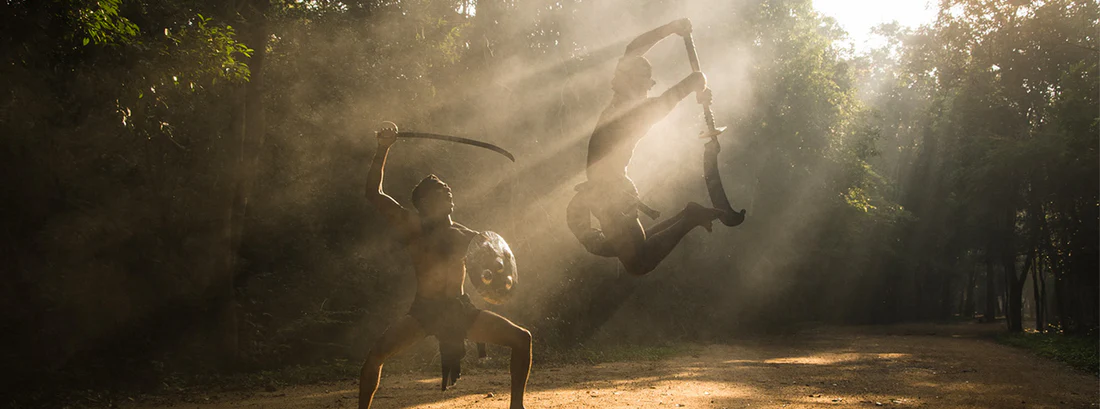
Hidden beneath centuries of suppression, a combat system unlike anything else in the world quietly survived in Sri Lanka. Angampora, the ancient indigenous martial art of the island, endured a British colonial ban that lasted nearly two hundred years, its knowledge passed in secret from master to student across generations. Today, following the lifting of restrictions in 2019, it is experiencing a cautious revival, and for visitors to Sri Lanka it offers one of the most fascinating windows into the country's warrior heritage.
This is not a performance art created for tourists. Angampora is a complete combat system with roots stretching back thousands of years, intertwined with Sri Lankan mythology, military history, and a philosophy of mind that goes far beyond fighting technique.
Fly into Colombo (CMB) to begin exploring Sri Lanka's extraordinary cultural heritage.
Planning a Trip to Sri Lanka?
Flights to Sri Lanka
Find the best price to Colombo from your city
Powered by Travelpayouts · We may earn a small commission at no extra cost to you.
Tip
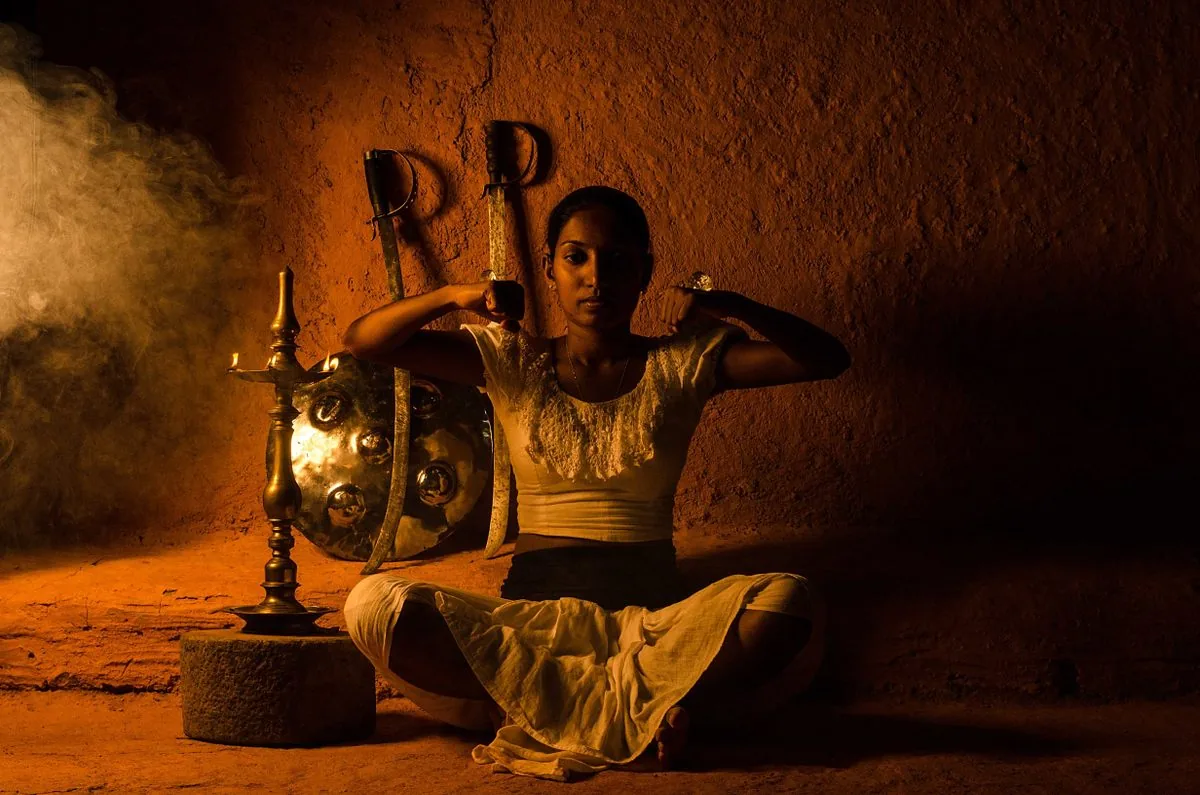
Our take: The surviving Angampora practitioners are concentrated in a small number of families in the Sabaragamuwa region - the art nearly died under colonial prohibition. Witnessing a demonstration requires planning and a local contact. The practitioners appreciate visitors who arrive with genuine curiosity rather than a camera only.
What Does "Angampora" Mean?
The name comes from two Sinhala words: angam, meaning body, and pora, meaning fight or combat. Translated directly, Angampora means "fighting with the body." It is a precise description of a system built entirely around using the human body as a weapon, with or without traditional arms.
Unlike imported martial arts such as karate or taekwondo, Angampora developed entirely within Sri Lanka, shaped by the island's specific geography, its wars, and the cultural values of the Kandyan kingdom. It has no direct equivalent anywhere in the world.
Origins: Myth, History and Ancient Texts
The precise origins of Angampora are contested, and the truth likely contains elements of all the major accounts. The art was transmitted orally rather than through written records, which means its early history is inseparable from the mythology of the island.
The Ravana Theory
The oldest origin story connects Angampora to King Ravana, the legendary ruler of ancient Lanka who features prominently in the Indian epic Ramayana. According to this tradition, Angampora is approximately 5,000 years old, with Ravana himself said to have been a master practitioner.
More significantly, Ravana is credited in these accounts with understanding not only how to apply pressure points to kill or incapacitate an opponent, but also how to use the same knowledge to heal. This dual understanding of the body as both vulnerable and recoverable became one of Angampora's defining characteristics, and later contributed to the development of Ayurvedic medicine in Sri Lanka.
The Yakkha Tribe Theory
A second tradition credits the Yakkha people, one of the indigenous tribes of ancient Sri Lanka, with developing Angampora roughly 3,000 years ago as a defensive strategy against foreign invaders. This account aligns more closely with the archaeological and historical record, placing the art's systematic development in a period when Sri Lanka faced repeated threats from across the Palk Strait.
Prehistoric Defense
Some contemporary masters suggest the most basic elements of the system are even older, rooted in the need of prehistoric islanders to defend themselves from dangerous animals in the Sri Lankan jungle. The low stances, awareness of environment, and emphasis on survival at all costs reflect this origin.
Note
What the Mahavamsa records: Sri Lanka's ancient chronicle, the Mahavamsa, references "Angam Satan Kala" (the fighting art) and describes its shamanic dimension, including ritualistic practices used by warriors before combat. This confirms the art's existence in the early centuries AD.
The Three Components of Angampora
Angampora is not a single fighting style but a complete combat system called Angam Satan Kala, comprising three distinct disciplines.
1. Angampora: Hand-to-Hand Combat
The core of the system is unarmed combat, built around four primary disciplines:
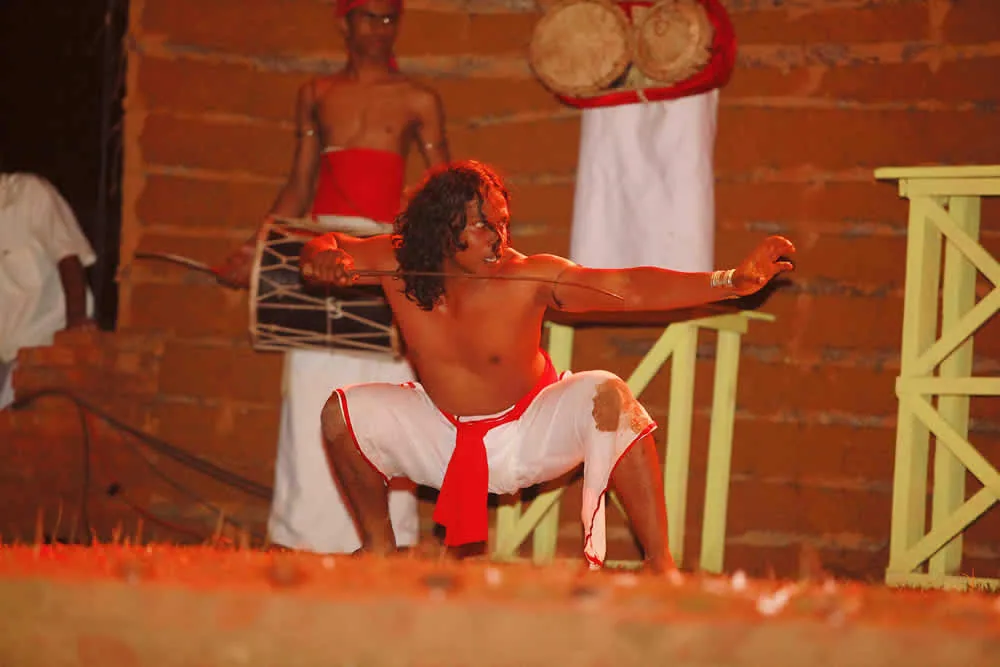
- Guti Harammba: striking techniques using fists, elbows, knees and feet
- Gata Harammba: locking and gripping methods, targeting joints and pressure points
- Pora Harammba: takedowns and wrestling techniques
- Maru Kala: lethal pressure point techniques, capable of killing, incapacitating, or healing
The pressure point knowledge within Maru Kala is the most closely guarded aspect of traditional Angampora. Masters historically withheld this component until a student had demonstrated years of character and discipline. Even today, full transmission of Maru Kala is rare.
2. Ilangampora: Weapons Training
The weapons dimension of the system incorporates 32 traditional weapons, with primary emphasis on the sword (kaduwa), long staff (poleya), mace (gada), and battle axe (waraya). Training in Ilangampora begins only after a student has built a foundation in unarmed combat, as the body mechanics are closely related.
3. Maya Angam: Shamanic Practice
The third and most obscure component involves the use of incantations, ritualistic preparation, and altered states of consciousness before combat. The Mahavamsa documents this dimension of the art, but contemporary practitioners who possess this knowledge are extremely rare. Maya Angam reflects the worldview of ancient Sri Lankan warriors, for whom physical and spiritual preparation were inseparable.
Angampora demonstrations and training schools are primarily based near Colombo and in the Kandy region.
Where to Stay in Sri Lanka
Hotels near Colombo
Compare prices across Booking.com, Agoda & more
Powered by Travelpayouts · We may earn a small commission at no extra cost to you.
The Seven Oaths of the Senior Practitioner
Progression in Angampora is not merely a matter of technical skill. Students who advance to the level of Jeshta Abhyasee (senior practitioner) must commit to seven binding oaths, known as the Diwurum Hatha. The content of these oaths varies between lineages, but they broadly cover ethical conduct, the responsible use of lethal knowledge, loyalty to the master, and the preservation of the tradition.
This ethical dimension separates Angampora from many modern martial arts. The seven oaths are considered as important as the physical training, and a student who breaks them is typically expelled from the lineage.
Angampora in Sri Lankan Military History
The Dasa Maha Yodayo
The most celebrated practitioners in Sri Lanka's recorded history are the Dasa Maha Yodayo, the Ten Great Giants, who served during the 2nd century BC. These warriors were not merely strong men but masters of Angampora, and their role in the defeat of South Indian invaders (particularly in support of King Dutugamunu) forms part of the national founding narrative.
Their names and deeds are recorded in the Mahavamsa, and they remain cultural heroes in Sri Lanka today. The Dasa Maha Yodayo represent the ideal of the complete warrior in the Angampora tradition: physically formidable, spiritually grounded, and utterly loyal to the protection of the island.
Battle of Mulleriyawa (1559)
One of the clearest demonstrations of Angampora in actual warfare came during the Battle of Mulleriyawa in the mid-16th century, when Sinhalese forces fighting under the Sitawaka Kingdom decisively defeated a Portuguese military expedition. Portuguese arquebusiers and soldiers trained in European combat were outmanoeuvred by fighters using Angampora techniques in close-quarters combat. The battle is considered one of the most significant military victories against European colonial forces in Asian history.
Similar engagements followed against Dutch forces, where Angampora masters operating in guerrilla conditions repeatedly neutralised technologically superior opponents.
The British Ban: Two Centuries of Suppression
The most dramatic chapter in Angampora's history came with the British colonial period, and specifically following the Uva-Wellassa Uprising of 1817–1818. This major rebellion against British rule drew heavily on Angampora-trained fighters, and Governor Robert Brownrigg recognized the art as a direct threat to colonial control.
The British response was systematic and severe:
- Angampora was formally banned across the island
- Training centres (angam maduwa) were destroyed
- British soldiers were ordered to shoot practitioners in the knees, deliberately crippling masters to prevent them from passing on their knowledge
- Possession of Angampora weapons became a punishable offence
The suppression was effective enough to drive the art almost completely underground. For nearly two centuries, Angampora survived only because certain families continued to train in secret, passing knowledge from father to son, at great personal risk.
Important
Historical note: The deliberate crippling of Angampora masters by British colonial forces is documented in Sri Lankan historical accounts. The practice was designed specifically to break the chain of transmission between teacher and student, and it nearly succeeded.
Survival and the Secret Lineages
The survival of Angampora is largely credited to a small number of families in the Kandy region and the western lowlands who refused to abandon the tradition despite the ban. Training moved into private homes and remote jungle clearings, with students sworn to absolute secrecy.
The most significant surviving lineage is associated with the Paragahagedara family of the Kotte region, though several other families claim unbroken transmission. The differences between these lineages in terms of technique, emphasis, and the extent of Maru Kala knowledge have become a matter of ongoing discussion among contemporary practitioners.
The 2019 Revival
The ban on Angampora was not officially lifted until 2019, nearly two centuries after it was imposed. This long-delayed recognition opened the door to public demonstrations, formal schools, and documentation efforts. Sri Lankan universities and cultural institutions began working with remaining masters to record techniques and oral histories before they are lost entirely.
The revival is genuine but fragile. Only fragments of the complete system survive, and masters who hold knowledge of Maru Kala in its fullness are very few. There is active debate within the Angampora community about how much should be publicly taught versus preserved within traditional lineages.
Where to See Angampora in Sri Lanka
Angampora demonstrations and training are increasingly accessible to visitors:
Angampora training schools (angam maduwa) have reopened in several locations near Colombo and in the Kandy region. Some accept visitors for demonstrations and introductory sessions.
Cultural shows in Kandy and Colombo occasionally incorporate Angampora demonstrations alongside traditional dance and drumming.
The Sri Lanka National Museum in Colombo holds weapons and documents related to the art's history.
If you are specifically interested in seeing authentic Angampora rather than staged performances, it is worth asking at your hotel or through a local guide for current training locations. The most authentic experiences tend to be informal, and the masters who teach are rarely publicised.
Tip
Visitor tip: Treat any Angampora master or practitioner you meet with the same respect you would show a scholar or artisan. This is an art that survived colonial suppression at enormous personal cost to those who preserved it. Approach it with curiosity and humility rather than as a spectacle.
Angampora and Ayurvedic Medicine
One of the lesser-known aspects of the Angampora tradition is its deep connection to Sri Lankan medicine. The pressure point knowledge encoded in Maru Kala, which maps the body's vital points for combat purposes, is essentially the same map used in traditional Sri Lankan healing practice.
Historically, Angampora masters were also healers. The ability to close off a vital point was paired with the knowledge of how to restore it. This integration of combat and medicine reflects a holistic understanding of the body that is unusual in any martial tradition and helps explain why Angampora is considered more than a fighting art by those who practise it seriously.
Why Angampora Matters for Sri Lanka
Angampora is not simply a martial art. It is an archive of Sri Lankan identity: a record of how the island defended itself, the values its warriors held, the connection between physical and spiritual discipline, and the costs of colonial suppression.
For visitors, encountering Angampora even briefly changes the way you see Sri Lanka's history. The country has an extraordinary story of resistance and cultural survival, and this ancient combat system, preserved in secret for two hundred years at enormous personal risk, is one of its most remarkable chapters.
It is a tradition that deserved to die according to those who banned it. The fact that it did not is a testament to the determination of the families who kept it alive in the dark.
Angampora and Other Asian Martial Arts
Angampora's relationship to other Asian martial arts traditions is debated among practitioners and historians. Some argue for direct connections to South Indian Kalaripayattu (considered by many historians as the ancestor of both Muay Thai and various Southeast Asian fighting styles). Others maintain Angampora developed independently on the island.
What is documented: Angampora and Kalaripayattu share several structural similarities - the use of vital point attacks (marma in Ayurvedic tradition), the integration of weapon and empty-hand combat, the role of a hereditary master (guru/ustaradaya) who controls transmission of techniques, and the emphasis on physical conditioning through yoga-like postures. Whether these reflect common ancestry or parallel development is unresolved.
What is distinct about Angampora: the specific weapons system (including the Vel, Illangam, and the distinctive Angam fighting staff), the lion-inspired combat postures, and the integration of Ayurvedic pressure-point knowledge are specific to the Sri Lankan context and do not appear directly in any other Asian martial tradition.
Frequently Asked Questions About Angampora
Can foreign visitors learn Angampora? Some schools accept foreign students for short introductory sessions. The traditional system is structured around long-term apprenticeship - meaningful skill requires months or years of commitment. What is available to short-term visitors is typically a demonstration and introductory workshop. Contact the Angampora Foundation directly for current student arrangements.
How is Angampora different from wrestling or kickboxing? Significantly different in philosophy and method. Angampora integrates weapon fighting, grappling, and striking into a unified system rather than specialising in one domain. The vital point (marma) targeting - using precise attacks on pressure points to disable rather than simply overpower an opponent - has no direct equivalent in Western combat sports.
Is Angampora available to watch as a tourist experience? Yes, with planning. Demonstrations can be arranged through Sri Lanka cultural tourism operators and through the Angampora Foundation. Major cultural festivals sometimes include demonstrations. Spontaneous tourist-facing shows do not exist - this is not a staged performance art but a living martial tradition, and access requires genuine engagement.
Why was Angampora banned by the British? The colonial administration perceived indigenous fighting systems that could train large numbers of men in combat as a political and military threat. The specific trigger for the ban in 1817 was the Uva-Wellassa Rebellion, in which Angampora practitioners fought alongside the uprising. The ban continued until independence in 1948.
Further reading and references:
Ready to explore Sri Lanka's extraordinary living heritage? Start planning your trip.
Plan Your Sri Lanka Cultural Journey
Find the best price to Colombo from your city
Search Flights →Compare prices across Booking.com, Agoda & more
Find Hotels →Bus fares, train times and transport options
Plan Transport →Powered by Travelpayouts · We may earn a small commission at no extra cost to you.
Related Guides
- Sri Lanka's Traditional Masks: The Art, the Ritual and Where to Find Them
- Maduwanwela Walawwa: Sri Lanka's Most Magnificent Royal Manor
- Sinhala & Tamil New Year: Sri Lanka's Most Important Festival Explained
- Geoffrey Bawa and Lunuganga: Sri Lanka's Greatest Architect and His Garden of Dreams
Advertisement
Flights, hotels and tours - all in one place.
Plan Your Sri Lanka Trip
Find the best price to Colombo from your city
Search Flights →Compare prices across Booking.com, Agoda & more
Find Hotels →Bus fares, train times and transport options
Plan Transport →Powered by Travelpayouts · We may earn a small commission at no extra cost to you.
Leave a Comment
Share your thoughts, questions, or travel experiences